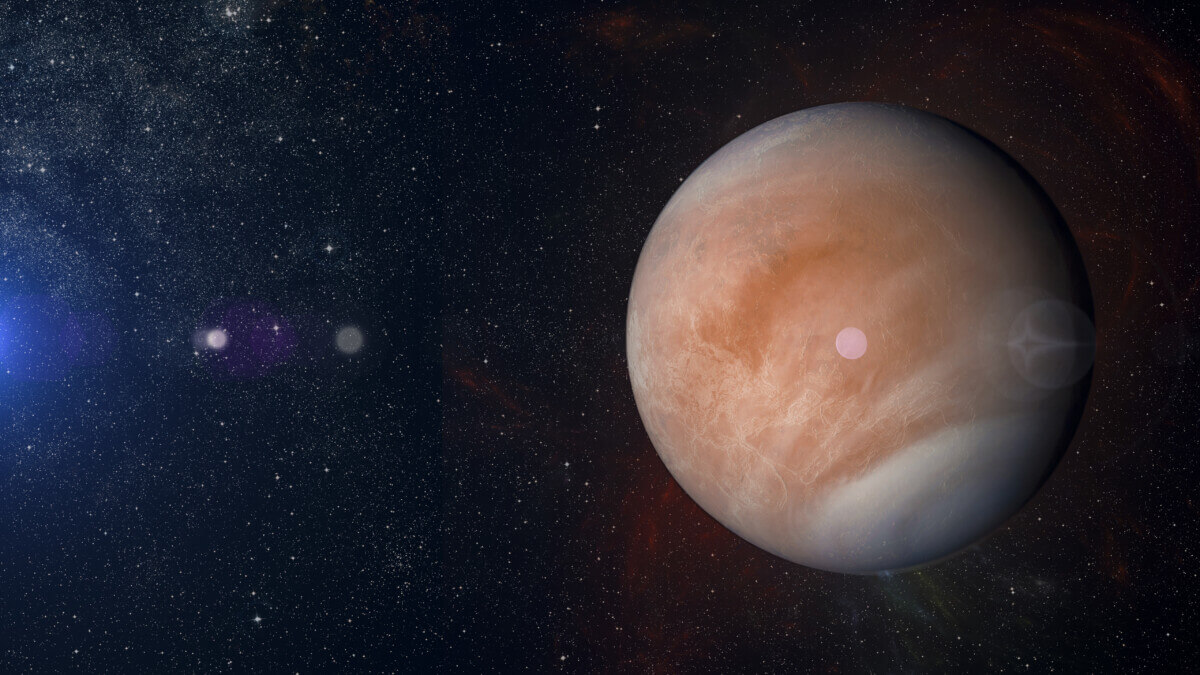
Artist's illustration of Venus. (© Igor_Filonenko - stock.adobe.com)
Astronomers warn that Venus’s orbital neighborhood may hide large space rocks that slip past Earth’s telescopes.
In A Nutshell
- Some asteroids orbit near Venus in paths that keep them hidden from Earth’s telescopes.
- Simulations show these objects could pack city-destroying impact power.
- Only 20 Venus co-orbital asteroids are known, but many more likely exist.
- Space-based telescopes near Venus may be the only way to detect them all.
SÃO PAULO — Scientists have spotted a major blind spot in how we watch for dangerous asteroids. New research shows that space rocks orbiting near Venus stay hidden from Earth’s telescopes, and some could pack enough punch to level an entire city.
Models suggest a still-undetected population of Venus asteroids exists, with some potentially measuring 300 to 390 meters across. These could release 150 to 410 megatons of TNT, enough to destroy a large city if one were to strike Earth.
Published in Astronomy & Astrophysics, the study shows these space rocks could carve craters up to 3.4 kilometers wide and cause destruction at a city-wide scale if one hit our planet.
“These objects could form craters with diameters from 2.2 to 3.4 km, and release energies at impacts ranging from 1.5 to 4.1 × 10² Megatons TNT, which is more than enough to destroy large cities,” the study states. That level of destruction ranks as level 8 on the Torino scale, meaning collisions capable of causing localized destruction.
Why These Space Rocks Stay Hidden
The problem asteroids are called Venus co-orbitals. They follow the same path around the Sun as Venus, cycling through different patterns over about 12,000 years. While Venus protects them from crashing into that planet, Earth gets no such protection.
Current telescopes struggle to spot these rocks for a simple reason: they only show up for short periods right after sunset or before sunrise, high up in the sky. The asteroids that do come closer to Earth appear brighter and easier to find, which means we’re missing the ones that stay farther away but could still hit us.
Most of the 20 known Venus asteroids have stretched-out orbits that bring them near Earth sometimes. But scientists now know many more exist in rounder orbits that keep them hidden while still posing a threat to our planet.

Computer Models Show the Hidden Danger
Advanced computer simulations reveal just how big this blind spot might be. Only 20 Venus asteroids are known today, but simulations suggest many more Venus co-orbital asteroids may exist than are currently cataloged.
The models show no preference for creating asteroids with stretched-out orbits. Instead, space rocks should be spread fairly evenly across different orbit shapes, meaning lots of hidden ones likely exist in the danger zone.
Scientists ran computer simulations tracking fake asteroids for 36,000 years and found specific areas where simulated asteroids could get uncomfortably close to Earth multiple times. In their computer models, five test particles came within extremely close distances of our planet.
Separately, previous research by the same team found six real Venus asteroids that could become potentially hazardous within the next 12,000 years, including three objects with very close minimum distances to Earth’s orbit.
Space Telescopes Offer the Best Solution
Ground-based telescopes face serious limitations, but missions in space could change everything. The upcoming Rubin Observatory might spot some of these objects when conditions are just right, but it still deals with the same problem of looking too close to the Sun.
Better options involve putting telescopes near Venus or at special points between the Sun and Venus where gravity balances out. These spots would let telescopes watch the inner solar system continuously without the Sun’s glare getting in the way.
NASA’s NEO Surveyor mission, planned for launch after 2027, will work from a position between Earth and the Sun. Even more ambitious ideas include the CROWN mission, with seven telescopes positioned near Venus that could spot more than 94% of potentially dangerous inner solar system objects.
“Space missions based on Venus’ orbits could be instrumental in detecting Venus’ co-orbitals at low eccentricities,” the researchers conclude.
Recent discoveries of asteroids inside Venus’s orbit highlight how many remain hidden until they pass close to Earth. Current surveys have made progress finding inner solar system objects, including asteroids with orbits completely inside Venus’s path.
Ground-based programs like the “low-SE twilight survey” planned by the Rubin Observatory represent one of the few Earth-based efforts designed to search closer to the Sun for objects that regular telescopes can’t detect.
“Low-e Venus co-orbitals pose a unique challenge, because of the difficulties in detecting and following such objects from Earth,” the study notes. The authors believe only dedicated space missions near Venus could map and find all the remaining potentially hazardous asteroids among Venus populations.
The research examines a broader challenge in planetary defense: potentially dangerous asteroids often remain hidden in the most difficult places to observe, creating ongoing detection challenges for astronomers worldwide.
Paper Summary
Methodology
Researchers used mathematical models of Venus’s orbital relationship with asteroids combined with computer simulations to track potential asteroid encounters with Earth. They created a grid covering different asteroid orbits from nearly circular to more stretched out, and different tilts compared to Venus’s orbit. For each setup, they created 36 test asteroids and ran their orbits forward 36,000 years using computer programs that account for gravitational pulls from all the planets. Scientists checked when these fake asteroids came close to Earth and tracked their closest possible approaches throughout the simulations.
Results
The study found specific orbits where Venus asteroids can pose collision hazards to Earth, with the dangerous region being larger for asteroids with orbits closer to Venus’s orbital plane. Most close encounters happened at the boundary where Venus asteroid farthest points equal Earth’s closest point to the Sun, but many asteroids in more circular orbits also showed potential for dangerous encounters. Ground-based observations from the future Rubin Observatory could detect some objects but remain limited by how close to the Sun they can look, with detection chances strongly linked to how stretched out the asteroid orbits are.
Limitations
The research acknowledges several constraints including that their mathematical model only gives snapshots of asteroid behavior and can’t predict long-term changes, requiring computer simulations for complete analysis. The 36,000-year simulation period, while covering three asteroid cycles, may not capture all possible orbital variations. Ground-based observation analysis focused only on visible light detection and assumed specific brightness values for theoretical objects. The study also noted that space mission proposals remain conceptual and face significant technical and funding challenges.
Funding and Disclosures
The research was supported by the Brazilian National Research Council, São Paulo Research Foundation, and Italian mathematical institutes. Authors declared no competing interests, and the study was conducted through international collaboration between institutions in Brazil, France, and Italy.
Publication Information
Carruba, V., Sfair, R., Araujo, R. A. N., Winter, O. C., Mourão, D. C., Di Ruzza, S., Aljbaae, S., Caritá, G., Domingos, R. C., and Alves, A. A. “The invisible threat: Assessing the collisional hazard posed by undiscovered Venus co-orbital asteroids,” published in Astronomy & Astrophysics, 699, A86 (July 2025). DOI: 10.1051/0004-6361/202554320


I remember from last year that I was glad to read that the Taurid Swarm was not as big of a threat that was previously believed (https://studyfinds.com/earth-doomsday-asteroid-swarms/).
Now this new research says that the threat still exists, just near Venus.
We just can’t catch a break 🙂