
There are different types of black holes, depending on their size and mass. The smallest ones are called primordial black holes, and they may have formed in the early universe. (Credit: faisalstudiobsp on Shutterstock)
Record-breaking neutrino detection may mark the first time humans witnessed a primordial black hole exploding, potentially solving age-old dark matter mystery.
In A Nutshell
- A neutrino detector in the Mediterranean caught the highest-energy neutrino ever recorded in 2023, and physicists think it came from an exploding primordial black hole, a relic from moments after the Big Bang
- Standard black holes can’t explain why this ultra-high-energy particle appeared before lower-energy ones at a bigger detector, creating a 1-in-5,000 statistical puzzle
- UMass Amherst researchers propose these ancient black holes carry a “dark charge” that keeps them dormant for billions of years before suddenly exploding, producing more ultra-high-energy particles than regular ones
- If correct, these exotic black holes could be all the dark matter in the universe, and we’re watching them reach their violent ends right now, 13.8 billion years after formation
In early 2023, a neutrino detector buried in the Mediterranean Sea recorded something extraordinary: a single particle carrying more energy than anything ever detected from space. Now, physicists at the University of Massachusetts Amherst think they know what created it. An exploding black hole from the dawn of time.
If they’re right, this observation doesn’t just mark the first detected black hole explosion in history. It might address three of the biggest mysteries in physics: what dark matter is made of, whether Stephen Hawking’s 50-year-old prediction about evaporating black holes holds true, and where ultra-high-energy neutrinos come from.
The detection came from KM3NeT, an array of sensors anchored to the seafloor that watches for flashes of light created when neutrinos slam into water molecules. The particle it caught, dubbed KM3-230213A, carried about 100 times more energy than anything produced in Earth’s most powerful particle accelerator. Meanwhile, IceCube, a larger, longer-running detector embedded in Antarctic ice, has recorded five extremely energetic neutrinos, but none approaching KM3NeT’s record.
IceCube has been observing for longer with more detection volume, so statistically, it should have spotted the more energetic particle first. Something about the source produces more particles at ultra-high energies than at merely very high energies. No known cosmic object behaves this way.
Why Exploding Black Holes Could Be the Answer
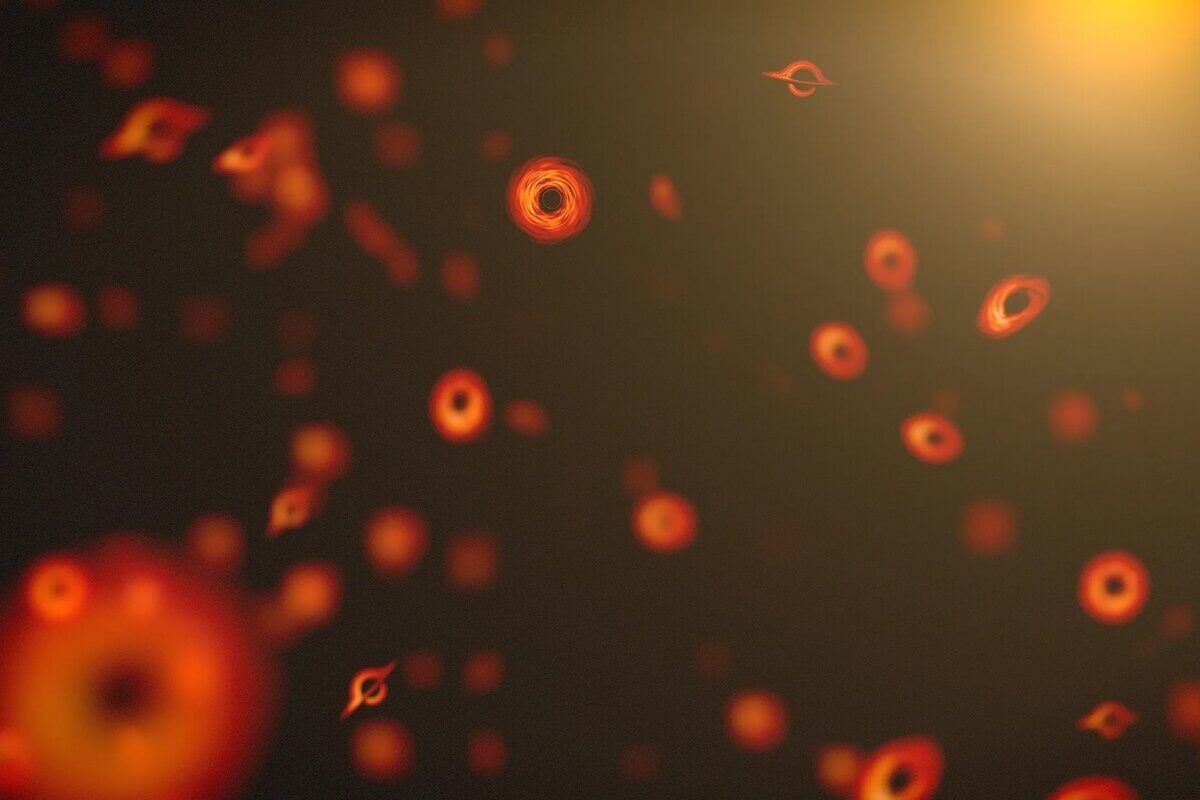
Michael J. Baker and his colleagues at UMass Amherst think the source isn’t a star or galaxy at all. They believe primordial black holes, relics formed in the universe’s first fraction of a second, are reaching the end of their lives and detonating in our cosmic neighborhood right now.
Here, “exploding” doesn’t mean a blast like a bomb or supernova, but rather a sudden final phase where the black hole releases its remaining energy very quickly through quantum processes.
Unlike black holes born from collapsed stars, primordial black holes could have formed with nearly any mass during the extreme conditions immediately after the Big Bang. Those formed with just the right initial mass would be finishing their slow evaporation today through Hawking radiation, the quantum glow Stephen Hawking predicted in 1974.
But there’s a problem. Simple black holes can’t explain both observations. The explosion rate needed to produce KM3NeT’s ultra-high-energy neutrino is roughly 1,000 times higher than the rate suggested by IceCube’s detections. Both rates also exceed limits set by measurements of gamma rays filling the universe.
The “Charged Black Hole” Solution
Baker’s team found an elegant solution: what if these ancient black holes carry an electric charge under a force we haven’t discovered yet?
The idea involves a “dark sector,” or a hidden realm of particles that barely interact with ordinary matter. In this model, primordial black holes formed with a small amount of “dark charge” related to a force carried by dark photons and heavy dark electrons.
Normally, a charged black hole would quickly shed its charge by emitting charged particles. But if dark electrons are incredibly massive, the black hole never gets hot enough to produce them. Instead, it loses mass by radiating photons and neutrinos while keeping its dark charge. As the black hole shrinks but stays charged, it enters a dormant “quasi-extremal” state where it becomes extraordinarily stable, like a battery that’s nearly full and stops draining.
These dormant black holes can coast along for billions of years, barely radiating. But eventually, the electric field around them grows so intense that it rips particle pairs out of empty space through quantum effects. This suddenly discharges the black hole, causing its temperature to spike and triggering an explosion.
The timing of this discharge solves the puzzle. By choosing the right properties for dark electrons, physicists can arrange for explosions that favor ultra-high-energy neutrinos over merely very-high-energy ones. The black hole still emits some lower-energy particles, but the suppression is enough to explain why IceCube sees relatively few events while KM3NeT caught a blockbuster.
The researchers calculated that when parameters align correctly, the burst rates from both experiments match. Each explosion produces far less low-energy radiation than a normal black hole, so the gamma ray limits are satisfied too.
Could These Be Dark Matter?
Under certain model assumptions, these primordial black holes could account for all the dark matter in the universe.
Dark matter, the invisible stuff making up 85% of the universe’s matter, has never been directly detected despite decades of searches. Physicists know it exists because galaxies rotate too fast to be held together by visible matter alone. If dark matter consists of these exotic black holes distributed throughout our galaxy, their occasional explosions would produce exactly the neutrino pattern being observed.
The study, published in Physical Review Letters, found the best fit when these black holes make up 100% of dark matter, with each weighing about 320 kilograms (roughly 700 pounds), but compressed into a volume billions of times smaller than an atom. They’d be everywhere, dotting the galaxy like invisible landmines, but each one spends billions of years dormant before its brief, violent finale.
The local explosion rate sounds absurd: about 10 billion per cubic parsec per year near Earth. But a cubic parsec is enormous, roughly 35 cubic light-years, so these events are still spread out across vast volumes of space. And remember, each explosion is far dimmer than expected because the black holes radiated most of their mass away slowly over cosmic time. Only the final moments produce the dramatic burst.
What Happens Next
The proposal makes testable predictions. Each explosion should produce ultra-high-energy gamma rays along with neutrinos. The HAWC gamma ray telescope was actually watching the region of sky where KM3NeT detected its neutrino but didn’t report a corresponding burst. Though, at these extreme energies, the detector’s sensors become saturated and overwhelmed, making it hard to separate signal from background noise. Future instruments with better sensitivity could catch both signatures at once.
Primordial black holes remain hypothetical. No one has definitively detected one, though various observations have been interpreted as candidates. Formation mechanisms depend on conditions during the universe’s first microsecond, an era where physics becomes speculative. The proposed dark sector is entirely theoretical too.
But the model ties together multiple mysteries. The tension between KM3NeT and IceCube vanishes. The absence of known astrophysical sources gets explained. Dark matter shifts from unknown particle to exotic black hole. And Hawking’s prediction about evaporating black holes, never directly confirmed in 50 years, finally gains observational support.
Whether the universe’s first black holes are exploding around us will become clearer as detectors gather more data. If KM3NeT keeps seeing ultra-high-energy events at a higher rate than IceCube, the case strengthens. If gamma ray telescopes catch a burst coinciding with a neutrino, the interpretation would become much harder to dismiss.
For now, one particle (KM3-230213A) offers a tantalizing hint that objects forged in the first moments after the Big Bang and aging slowly through billions of years of cosmic history are reaching their spectacular endpoints in our own era. And humanity finally has the technology to watch them die.
Paper Notes
Limitations
This analysis relies on several theoretical assumptions. First, primordial black holes must actually exist and have formed with the specific mass and charge distributions proposed. Formation mechanisms remain uncertain and depend on poorly understood physics from the universe’s first fraction of a second. Second, the dark sector—including the dark photon, dark electron, and dark U(1) force—is hypothetical. No experimental evidence currently supports these particles, though they remain consistent with existing constraints. Third, calculations become uncertain for extreme charge parameters, requiring extrapolation methods. Fourth, the analysis assumes neutrinos travel through empty space without interaction. Finally, the study doesn’t account for contributions from extragalactic primordial black holes.
The comparison with IceCube uses flux measurements with statistical uncertainties, particularly at the highest energies where few events exist. The KM3NeT result relies on a single event, making statistical conclusions limited. Future observations are necessary to confirm the pattern.
Funding and Disclosures
The paper acknowledges support from the University of Massachusetts, Amherst, and the Amherst Center for Fundamental Interactions. No competing financial interests or conflicts of interest were declared.
Publication Details
Authors: Michael J. Baker, Joaquim Iguaz Juan, Aidan Symons, and Andrea Thamm | Affiliation: Department of Physics, University of Massachusetts, Amherst, MA 01003, USA | Paper Title: “Explaining the PeV Neutrino Fluxes at KM3NeT and IceCube with Quasi-Extremal Primordial Black Holes” | Journal: Physical Review Letters


