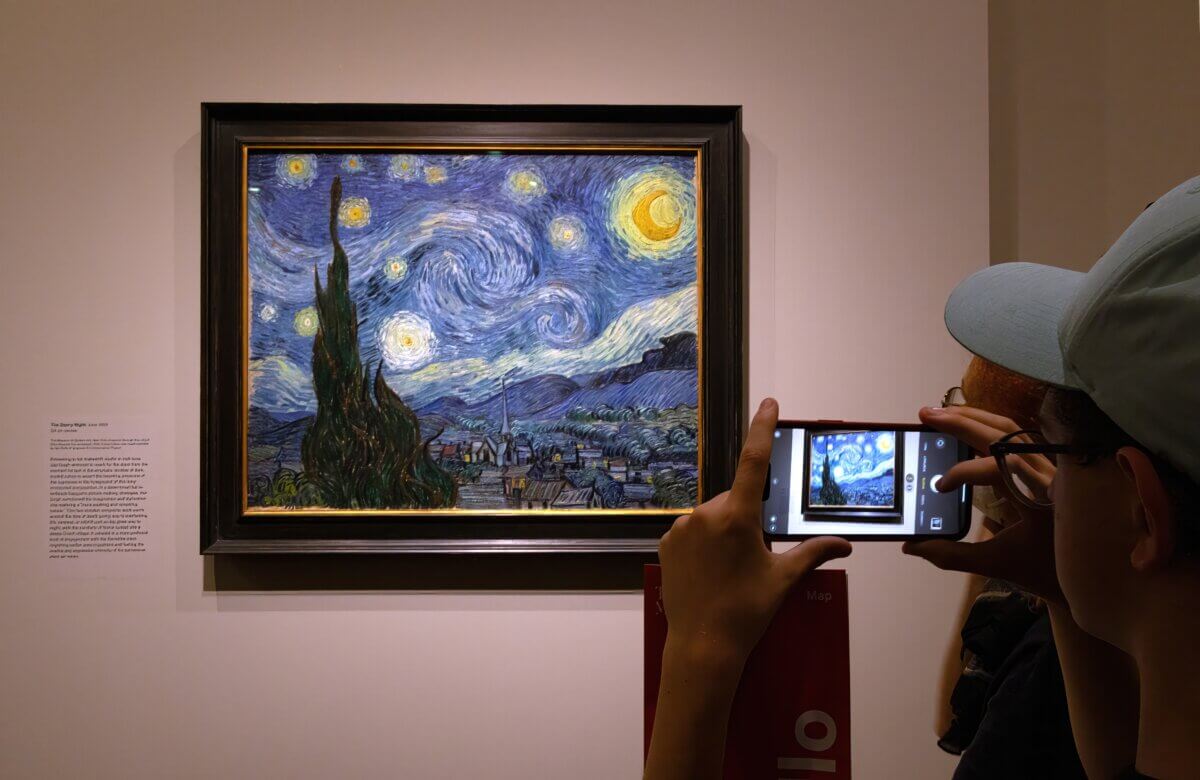
Tourist photographing a famous Starry Night painting by Van Gogh (Credit: spatuletail/Shutterstock)
WASHINGTON — Have you ever gazed at Vincent van Gogh’s iconic painting “The Starry Night” and felt like you could almost see the sky moving? Well, it turns out that your eyes weren’t playing tricks on you. A team of researchers has discovered that the swirling patterns in van Gogh’s masterpiece actually mirror real-world atmospheric turbulence with surprising accuracy!
In a fascinating blend of art and science, researchers from China and France have taken a closer look at the night sky as depicted by van Gogh. Their findings, published in the journal Physics of Fluids, suggest that the Dutch post-impressionist painter may have captured more than just the beauty of the night – he may have inadvertently illustrated complex physical phenomena.
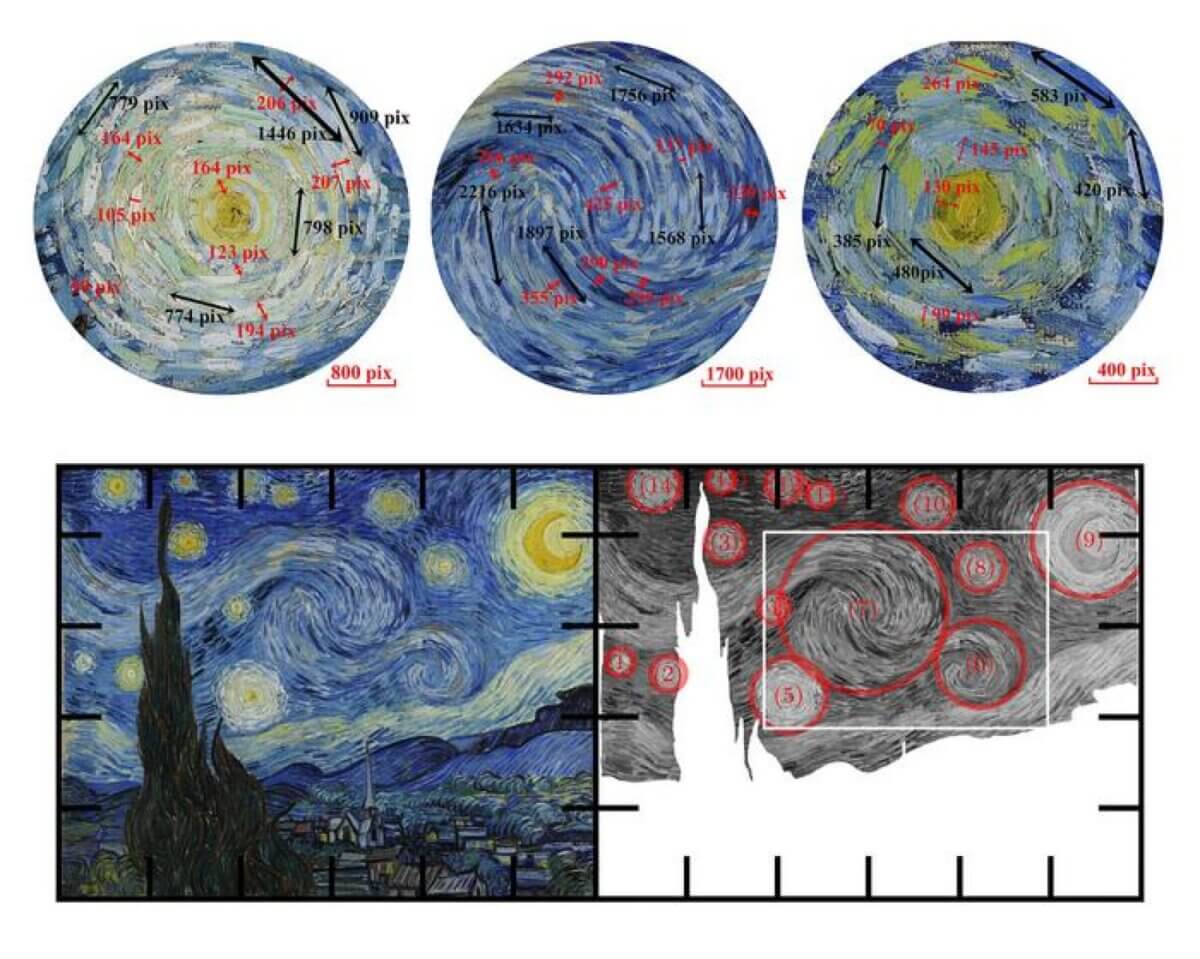
“The scale of the paint strokes played a crucial role. With a high-resolution digital picture, we were able to measure precisely the typical size of the brushstrokes and compare these to the scales expected from turbulence theories,” explains Yongxiang Huang, the study’s lead author, in a media release.
What exactly is turbulence, and why is it important?
Think of turbulence as the chaotic motion of fluids – in this case, air. It’s what makes airplane rides bumpy and creates those mesmerizing swirls in your coffee when you stir in cream. In the atmosphere, turbulence plays a crucial role in weather patterns and the mixing of air.
The researchers used some clever techniques to analyze van Gogh’s brushstrokes. They treated the varying brightness of the paint colors as a stand-in for the energy of physical movement in the atmosphere. It’s like using the leaves swirling in the wind to understand the wind itself.
What they found was astonishing. The patterns in “The Starry Night” align with two important principles in fluid dynamics: Kolmogorov’s law and Batchelor’s scaling. Don’t worry if these terms sound like gibberish – let’s break them down.
Kolmogorov’s law describes how energy moves from larger to smaller scales in turbulent flows. Imagine a big whirlpool breaking down into smaller and smaller eddies. This is what happens in the atmosphere, and amazingly, it’s what van Gogh’s larger swirls seem to depict.
Batchelor’s scaling, on the other hand, deals with how small-scale turbulence behaves. The researchers found that the fine details in van Gogh’s brushstrokes match this principle, which describes how substances like heat or pollutants spread in a turbulent fluid.
Finding both of these patterns in one system is rare, which makes this discovery even more exciting.
“It reveals a deep and intuitive understanding of natural phenomena. Van Gogh’s precise representation of turbulence might be from studying the movement of clouds and the atmosphere or an innate sense of how to capture the dynamism of the sky,” Huang says.
This study isn’t just about appreciating van Gogh’s artistic genius – it could have real-world implications. Understanding turbulence is crucial for many fields, from weather forecasting to aerospace engineering. The fact that an artist in the 19th century could capture these complex dynamics so accurately is mind-boggling.
The team adds that it’s important to note the limitations of this study. The researchers were working with a still image, not actual moving air. They also focused on specific parts of the painting, and analyzing different areas might yield different results. Let’s also not forget — “The Starry Night” is still a work of art, not a scientific diagram.
Nevertheless, this research opens up exciting possibilities for the intersection of art and science. It shows that beauty and scientific accuracy aren’t mutually exclusive – in fact, they might be more closely linked than we realize.
So, the next time you look at “The Starry Night,” remember that you’re not just seeing a beautiful painting. You’re witnessing a snapshot of the swirling, turbulent dance of the atmosphere, captured by an artist who may have understood more about the physics of the sky than anyone realized.
Paper Summary
Methodology
The study investigated patterns of turbulence in Vincent van Gogh’s famous painting The Starry Night. The researchers focused on analyzing the swirls and eddies in the painting to see if they followed the same mathematical rules that govern real-world turbulent flows. They used a high-resolution version of the painting, converted it to grayscale, and isolated the swirling parts of the sky for study. Then, they applied mathematical tools such as the Fourier power spectrum and second-order structure functions to measure the patterns and check if they matched known turbulence models.
Key Results
The study found that van Gogh’s swirls in The Starry Night really do follow some of the same rules that real turbulence does. The swirls showed two main patterns: one that matched a well-known turbulence theory (Kolmogorov’s −5/3 scaling) and another that matched a different turbulence pattern (Batchelor’s −1 scaling). This means that van Gogh’s painting may be more scientifically accurate than people might think, especially in the way it captures how energy flows in turbulent air.
Study Limitations
One of the main limitations of this study is that it relied on analyzing a still image, not actual turbulent motion, which means the results can only go so far in confirming scientific turbulence. Also, different parts of the painting were analyzed in previous studies, and that led to conflicting findings. The researchers only focused on specific swirls in the painting, and the results might change if more of the painting or different areas were included. Another limitation is that the turbulence models were applied to an artistic creation, so it’s not the same as studying real fluid flows.
Discussion & Takeaways
This study shows that van Gogh may have captured the natural patterns of turbulence with incredible precision. It adds to the ongoing conversation about the intersection of art and science, showing how something visually beautiful can also reflect complex scientific principles. The findings suggest that even though The Starry Night is a work of imagination, it mimics real natural processes, like the way air moves in turbulent flows. The study highlights that science can sometimes be found in unexpected places, like a painting.
Funding & Disclosures
The research was funded by the National Natural Science Foundation of China under projects 12102165 and U22A20579. The authors declared no conflicts of interest. Data for the study were available through public platforms like Google Arts and Culture and other online art repositories.


