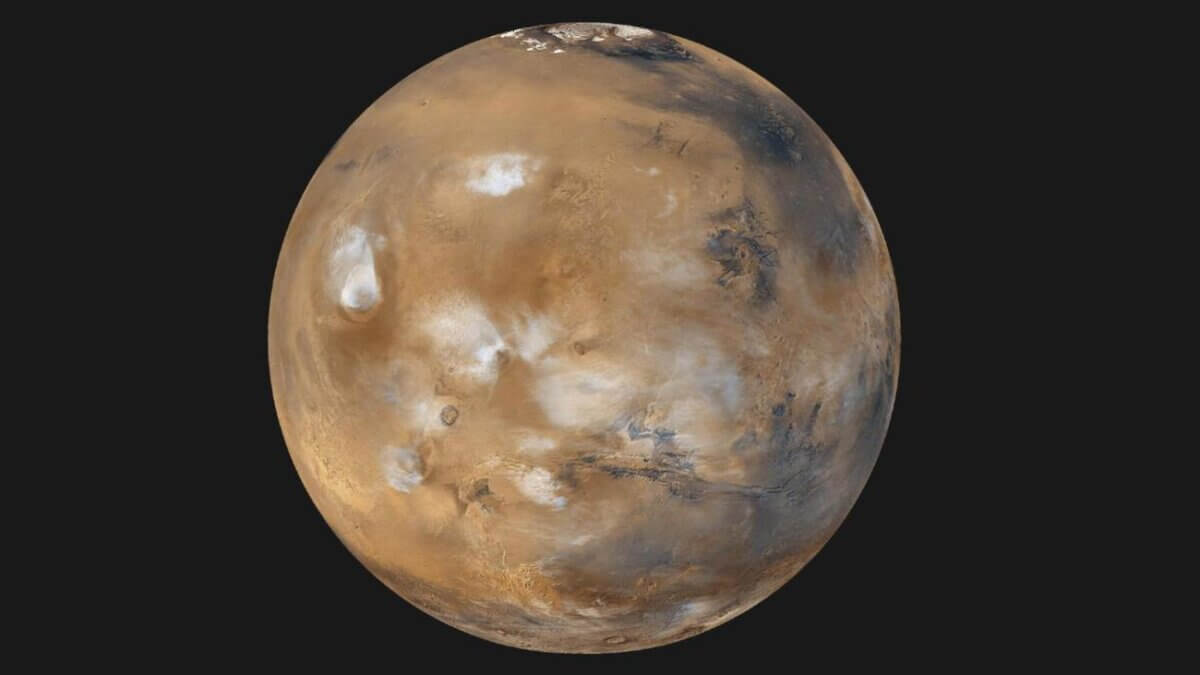
A new method that uses engineered dust particles released to the atmosphere could potentially warm the Red Planet to temperatures suitable for microbial life—a crucial first step towards making Mars habitable. Above, an image of Mars stitched together from photos taken by NASA’s Mars Global Surveyor Orbiter. (Image courtesy NASA/JPL/MSSS)
CHICAGO — In the annals of space exploration, few dreams have captivated the human imagination quite like terraforming Mars — the process of turning a barren planet into an Earth-like world. Now, a team of scientists has proposed a revolutionary method that could bring this sci-fi fantasy one step closer to reality. Their secret weapon? Engineered dust particles no larger than a speck of glitter.
A groundbreaking study published in Science Advances suggests that by releasing specially designed nanoparticles into the Martian atmosphere, we could potentially warm the Red Planet by more than 50 degrees Fahrenheit – enough to make it suitable for microbial life. This audacious plan, devised by researchers from the University of Chicago, Northwestern University, and the University of Central Florida, represents a quantum leap in our approach to planetary engineering.
The concept is deceptively simple: create tiny rod-shaped particles that interact with both sunlight and heat in ways that natural Martian dust cannot. These engineered nanorods would be designed to scatter incoming sunlight towards the surface while trapping heat that would otherwise escape into space. The result? A supercharged greenhouse effect that could transform Mars’ frigid landscape into a more hospitable environment.
What sets this proposal apart from previous terraforming schemes is its remarkable efficiency and use of locally available resources.
“This suggests that the barrier to warming Mars to allow liquid water is not as high as previously thought,” says Edwin Kite, an associate professor of geophysical sciences at the University of Chicago and the study’s corresponding author, in a media release.
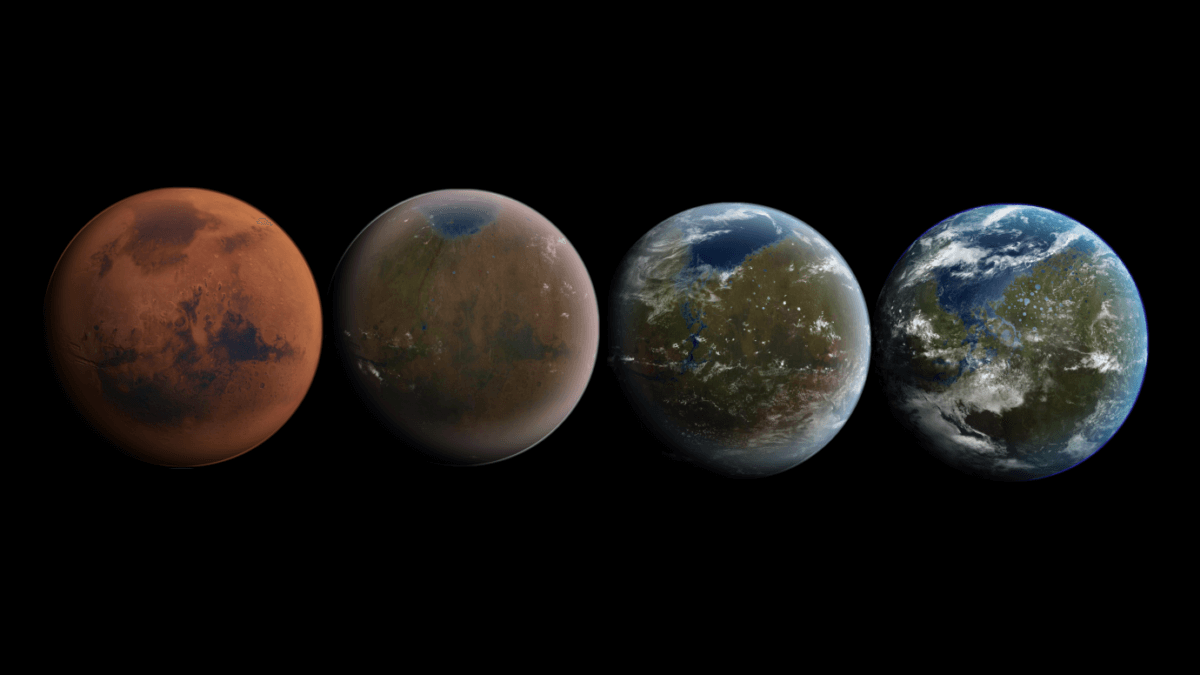
Unlike earlier plans that relied on importing massive quantities of greenhouse gases from Earth or mining rare Martian materials, this approach leverages elements abundant in Mars’ own soil. The nanorods would be manufactured from iron and aluminum, both plentiful in Martian dust. This local sourcing makes the project far more feasible than previous proposals.
The researchers’ calculations indicate that releasing these particles at a rate of just 30 liters per second – comparable to the flow of a garden hose – could raise Mars’ average temperature by over 50°F within a decade. This warming would be enough to allow liquid water to exist on the surface during the warmest parts of the year, particularly in mid-latitude regions where underground ice is common.
“You’d still need millions of tons to warm the planet, but that’s five thousand times less than you would need with previous proposals to globally warm Mars,” Kite explains. “This significantly increases the feasibility of the project.”
While this method represents a significant leap forward in terraforming research, it’s important to note that it’s just a first step. The goal is to make Mars hospitable for microbes and potentially food crops, not to create a breathable atmosphere for humans.
“To implement something like this, we would need more data from both Mars and Earth, and we’d need to proceed slowly and reversibly to ensure the effects work as intended,” Kite cautions.
The implications of this research extend beyond Mars. The authors suggest that if alien civilizations exist, they might use similar nanoparticle techniques to warm cold planets. Future telescopes could potentially detect these particles in exoplanet atmospheres as a “technosignature” of intelligent life.
Paper Summary
Methodology
The researchers used advanced computer simulations to model how the proposed nanoparticles would interact with light and heat on Mars. They calculated the optical properties of aluminum nanorods using finite-difference time-domain simulations, then fed this data into both 1D and 3D climate models of Mars. These simulations showed how adding different amounts of nanorods to the atmosphere would affect temperature, pressure, and other climate factors across the planet’s surface.
Key Results
The climate models indicated that a relatively small amount of nanorods – about 160 milligrams per square meter of Mars’ surface – could raise average temperatures by over 50°F (30°C). This warming would be enough to allow liquid water to exist on the surface during the warmest parts of the year in many locations. The nanorods were found to be over 5,000 times more effective at warming, per unit of mass, than the best greenhouse gases previously proposed.
Study Limitations
The authors note several important limitations and uncertainties in their work. The climate models make various simplifying assumptions and do not fully capture all the complex feedback effects that could occur in Mars’ atmosphere. The long-term behavior and fate of the nanoparticles is also uncertain – they may clump together or interact with dust and ice in unpredictable ways. Additionally, manufacturing the particles on Mars would be an enormous engineering challenge requiring major advances in technology.
Discussion & Takeaways
While the results are intriguing, the authors emphasize that this is just an initial feasibility study. Much more research would be needed before seriously considering such a project. They suggest several areas for future work, including more sophisticated climate modeling, experiments with nanoparticle production and behavior, and analysis of potential risks and side effects. The key takeaway is that nanoparticle-based climate modification appears to be a potentially viable approach that merits further study.
Funding & Disclosures
The authors used computational resources at Northwestern University’s Quest high-performance computing facility and the University of Chicago Research Computing Center. No external funding specifically for this research was mentioned in the press release.


Where are the plans for building a magnetic field for the planet? Without it, life as we know it would be impossible due to radiation damage. Underground living must start with surface construction on a massive scale, all with robot technology since human operators would not survive the project. Any work-arounds in the books?
Isn’t this how one of the Alien Movies started?