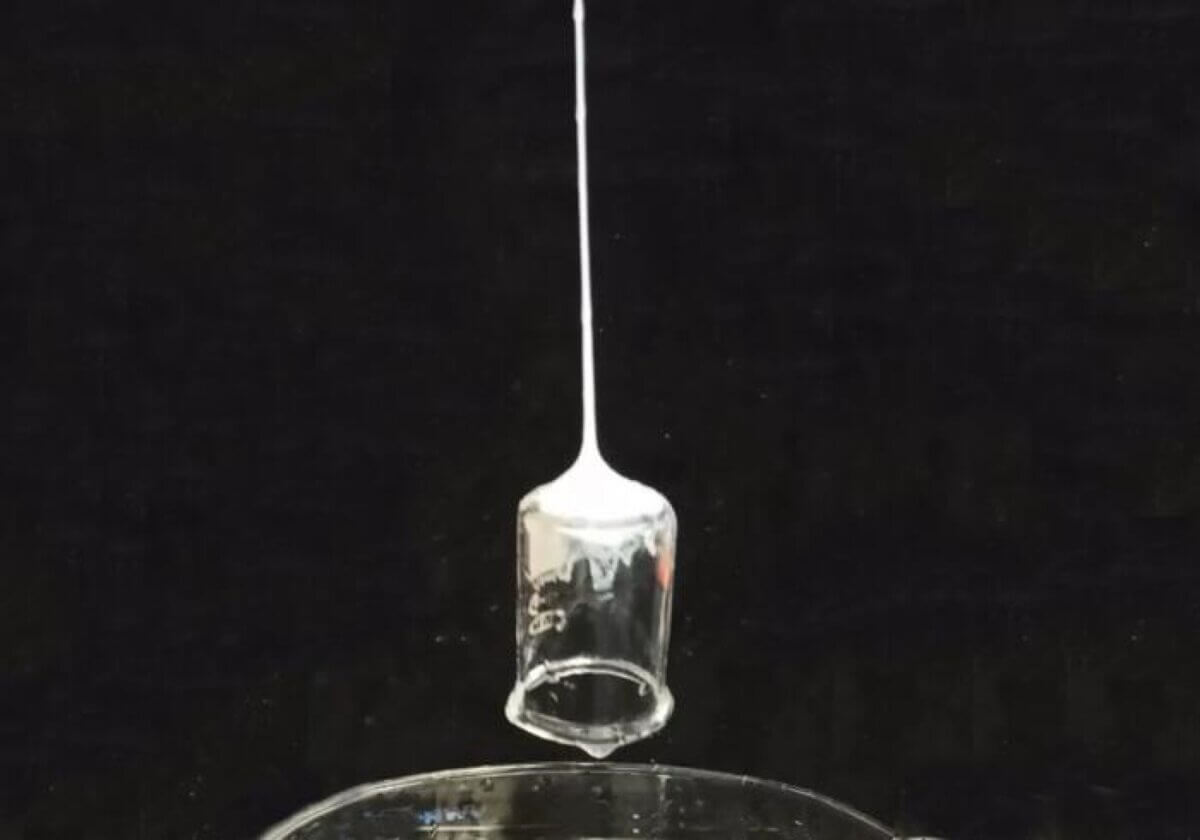
Liquid stream of silk solution solidifies to a fiber, adheres to and lifts a glass laboratory beaker (Credit: Marco Lo Presti, Tufts University)
MEDFORD, Mass. — Marvel fans, rejoice! Your dream of becoming the next friendly neighborhood Spider-Man is coming true. Scientists at Tufts University have recreated a strong web-slinging fiber similar to the one that allowed the superhero to shoot webs from their wrists and fly over streets. While you won’t be capturing villains, this web-slinging silk could soon help lift objects with impressive holding power.
The sticky fibers are not made from spiders but from silk moth cocoons. In a study now published in Advanced Functional Materials, the authors describe boiling the silk moth cocoons to break down a protein called fibroin. With additives added, the silk fibroin solution is loaded and released through narrow needles to form a stream that solidifies into a fiber when exposed to air. Several experiments showed the web’s adhesiveness and elasticity could easily stick and raise materials.
“As scientists and engineers, we navigate the boundary between imagination and practice. That’s where all the magic happens,” says Fiorenzo Omenetto, the Frank C. Doble Professor of Engineering at Tufts University and director of the Silklab, in a media release. “We can be inspired by nature. We can be inspired by comics and science fiction. In this case, we wanted to reverse engineer our silk material to behave the way nature originally designed it, and comic book writers imagined it.”
Like how Spider-Man got his powers, the discovery was entirely an accident.
“I was working on a project making extremely strong adhesives using silk fibroin, and while I was cleaning my glassware with acetone, I noticed a web-like material forming on the bottom of the glass,” explains study co-author Marco Lo Presti, a research assistant professor at Tufts University.
The accident became an opportunity, as it overcame some engineering challenges to create synthetic silk resembling the ones spiders wove. Silk fibroin solutions could form a semi-solid hydrogel when exposed to ethanol or acetone for a couple of hours. Dopamine — a chemical used for making adhesives — allows the material to form into a solid immediately. The organic solvent wash is quickly mixed, and the silk solution creates sticky and tough fibers.
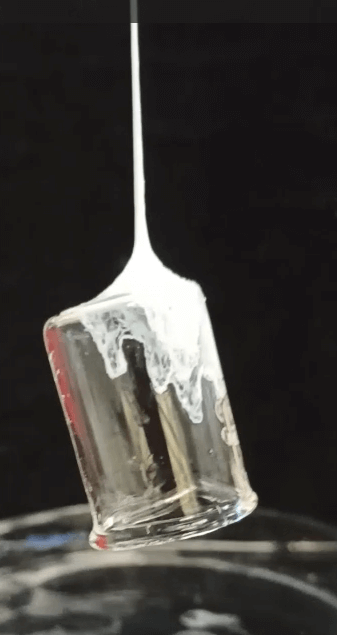
The next step was to test the strength of the fibers. Researchers added dopamine to the silk fibroin solution to pull water from the silk, resulting in an expedited process from liquid to solid phase. The thin layer of silk solution was released through a coaxial needle and coated with a layer of acetone to trigger solidification.
Acetone then evaporated mid-air to create a fiber that stuck onto the object it encountered. To increase the silk’s effectiveness, scientists also added chitosan. This is a sugar found in insect exoskeletons that makes the durability of the fibers 200 times stronger. Additionally, they included a borate buffer to increase adhesiveness about 18-fold.
Lab-made silk fibers were the diameter of a human hair to about half a millimeter, depending on the needle. The device could shoot fibers that picked up objects 80 times their weight. For example, the silk fibers lifted a cocoon, a steel bolt, a laboratory tube floating on water, a scalpel semi-buried in sand, and a wood block 12 centimeters away.
“If you look at nature, you will find that spiders cannot shoot their web. They usually spin the silk out of their gland, physically contact a surface, and draw out the lines to construct their webs,” Lo Presti notes. “We are demonstrating a way to shoot a fiber from a device, then adhere to and pick up an object from a distance. Rather than presenting this work as a bio-inspired material, it’s really a superhero-inspired material.”
Still, nothing beats the original. Spider-woven silks remain 1,000 times stronger than the man-made fibers described in the study. Spiders are not the only animals that produce silk threads. Ants, wasps, bees, butterflies, moths, beetles, and flies can also produce silk during their lifecycle.
Replicating similar silk fibers can be used for many applications. The main silk protein has been used before to make powerful glues that work underwater, printable sensors for any surface, edible coatings to extend the shelf life of produce, a light-collecting material that could make solar cells more effective, and sustainable methods for making microchips.
Paper Summary
Methodology
This study focused on creating a material inspired by nature’s adhesives, such as spider silk and mussel proteins. The researchers combined silk fibroin, a protein from Bombyx mori silk, with dopamine, a compound known for its sticky properties, to form a composite material. This composite solution, referred to as RSF-DA, was tested for its ability to form strong, flexible, and sticky fibers.
The solution was injected into acetone using specialized equipment to form these fibers instantaneously. By adjusting the concentration of dopamine and adding fillers like chitosan or borate buffer, they controlled the fibers’ mechanical and adhesive properties. These fibers were tested for their strength and adhesive capabilities using lap-shear tests and tensile strength measurements.
Key Results
The researchers found that by mixing dopamine with the silk fibroin solution, they could quickly form hydrogel fibers with adhesive properties. These fibers were strong enough to lift objects and could be adjusted to stick better or stretch further, depending on the additives used.
For instance, adding chitosan made the fibers stiffer, while borate buffer improved their stickiness. The strongest fiber could lift objects 80 times its own weight, and the adhesive fibers could be fine-tuned to work on different materials like glass, wood, and plastic. In short, the team successfully made fibers that can be used to grab objects from a distance, similar to spider webs.
Study Limitations
The fibers worked best in controlled environments, and their performance varied depending on the surface material. The effectiveness of the fibers also depended on their composition, and the process of creating them required precise conditions that may be challenging to replicate outside a laboratory. Additionally, while the fibers were strong enough to lift small objects, more research is needed to scale this up for larger or more practical applications.
Discussion & Takeaways
This study demonstrates an innovative approach to creating bioinspired materials that could be useful in fields like robotics, medicine, or material science. The creation of strong, adhesive fibers that can be deployed from a distance opens up new possibilities for capturing and retrieving objects in ways that were previously only seen in nature or fiction.
While the technology is still in its early stages, it shows significant potential for developing new adhesives and materials that can be fine-tuned for different tasks. The key takeaway is that nature-inspired designs, especially from spiders and mussels, can lead to breakthrough technologies with wide-ranging applications.
Funding & Disclosures
The research was conducted by scientists from Tufts University and the University of Bari, with no reported commercial or financial conflicts of interest.


