What happened before the Big Bang? (Credit: Triff/Shutterstock)
AUSTIN — If you could weigh the universe, you’d find that about 85% of its matter is missing – or rather, invisible to our most sophisticated detection methods. This cosmic accounting error, known as dark matter, has long been one of science’s greatest mysteries. Now, researchers have discovered that this invisible mass might have formed in the universe’s prenatal period, even before what we traditionally think of as the Big Bang.
The intriguing new study from a team at the University of Texas at Austin offers a tantalizing origin story for this cosmic enigma. The researchers propose that dark matter might have been created during one of the most fundamental moments in universal history — a brief, explosive period of expansion called cosmic inflation that occurred just before the Big Bang.
Scientists have believed that dark matter made up roughly 85% of all matter in the cosmos, even though they couldn’t actually see it. The new study adds another wrinkle in this cosmic mystery, suggesting this substance somehow existed before the event that many consider the beginning of time.
“The thing that’s unique to our model is that dark matter is successfully produced during inflation,” says Katherine Freese, lead researcher and director of the Weinberg Institute of Theoretical Physics, in a media release. “In most models, anything that is created during inflation is then ‘inflated away’ by the exponential expansion of the universe, to the point where there is essentially nothing left.”
The research, published in the journal Physical Review Letters, introduces a novel mechanism called WIFI (Warm Inflation Freeze-In), which suggests that dark matter could have been generated during the universe’s earliest moments through tiny, rare interactions within an incredibly hot and energetic environment.
Most cosmologists now understand that the universe’s beginning was far more complex than a simple explosive moment. Before the Big Bang, matter and energy were compressed into an incredibly dense state so extreme that physicists struggle to describe it. A fraction of a second of rapid expansion — inflation — preceded the more familiar Big Bang, setting the stage for everything that would follow.
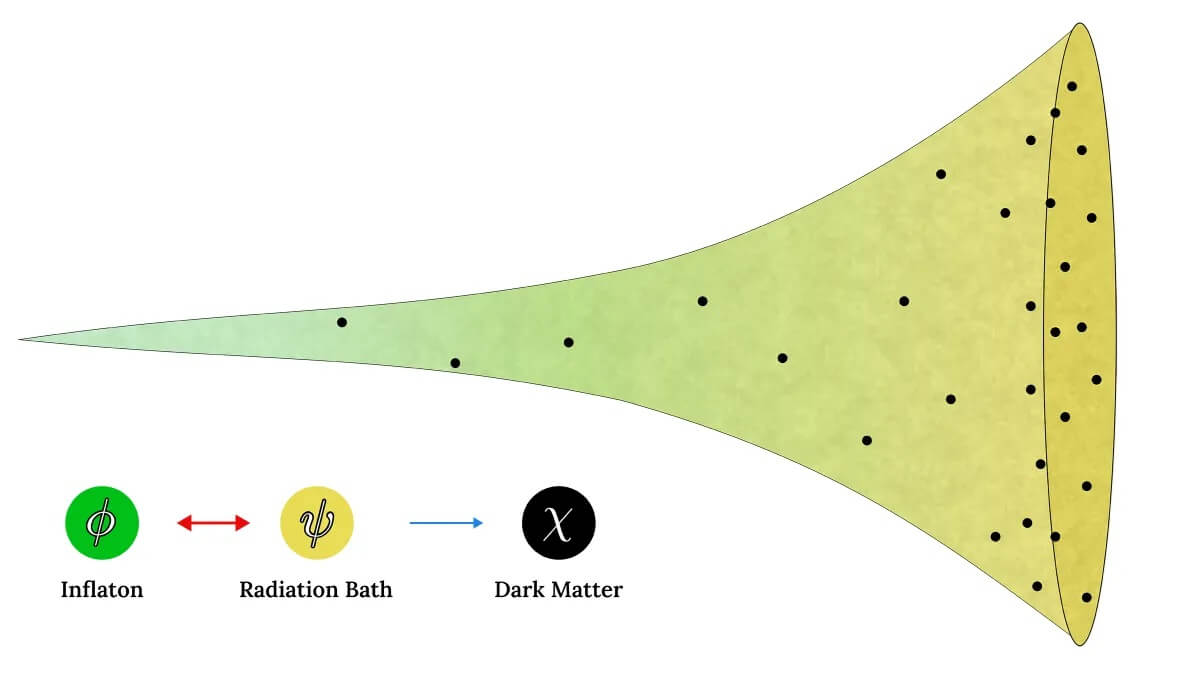
In this new model, the quantum field driving inflation loses some of its energy to radiation, which then produces dark matter particles through a process called freeze-in. The most remarkable aspect of the research is its suggestion that all the dark matter we observe today could have been created during that brief inflationary period.
What makes this new WIFI mechanism so revolutionary is its efficiency. The researchers found that it could produce dramatically more dark matter than conventional models – in some cases, up to 18 orders of magnitude more. That’s like comparing a teaspoon of water to all the oceans on Earth.
“In our study, we focused on the production of dark matter, but WIFI suggests a broader applicability, such as the production of other particles that could play a crucial role in the early universe’s evolution,” notes researcher Barmak Shams Es Haghi.
This theory opens up exciting new avenues for exploring the universe’s fundamental building blocks. While currently unconfirmable through direct observation, the researchers are optimistic. Graduate student Gabriele Montefalcone points out that upcoming experiments studying the Cosmic Microwave Background and large-scale universal structures could provide crucial validation.
“If future observations confirm that warm inflation is the correct paradigm, it would significantly strengthen the case for dark matter being produced as described in our framework,” Montefalcone concludes.
Paper Summary
Methodology
The team employed advanced mathematical modeling to simulate dark matter production during warm inflation. By developing sophisticated numerical code, they could explore how different interaction parameters might influence dark matter generation during the universe’s earliest moments.
Key Results
The research revealed that dark matter production during warm inflation could be dramatically more efficient than previously thought. Depending on specific interaction strengths, the model suggests that nearly all observable dark matter could have been produced during the inflationary period.
Study Limitations
As a purely theoretical study, the research relies on mathematical models that cannot be directly verified with current observational technologies. The findings assume specific conditions about the early universe that remain hypothetical.
Discussion & Takeaways
The study provides a revolutionary perspective on dark matter’s origins, challenging existing models and suggesting that the inflationary period might be far more dynamic than previously understood. It offers a new framework for conceptualizing cosmic evolution and matter creation.
Funding & Disclosures
The research was supported by the U.S. Department of Energy, the Swedish Research Council, and the Jeff and Gail Kodosky Endowed Chair in Physics at the University of Texas at Austin. The authors declare no conflicts of interest.


I love science but theories like these go way over my head. Is the big bang thought to be a singular event or a cycle of expansion, contraction and a bang?
Might want to check your fact check. Before? Cosmic inflation? That’s just after, not before. Title and 2 paragraph
It’s an interesting idea, but maybe my limited understanding of astrophysics is causing me to misunderstand something. I’ve always envisioned inflation being like the shockwave of a nuclear weapon… except obviously in the wrong spot in terms of sequence. If that’s the case, then the study doesn’t show what existed prior to the big bang, but rather gives some mathematical clarity to one aspect of it… which is cool, don’t get me wrong… but pre-big bang it is not.
Not to get too nitpicky but I also found it a little distracting when the article reads at a couple of points, “…. the observable dark matter in the universe”. If the author of this article knows how to detect dark matter via observation, I think it’d be nice to tell the rest of us (all of humanity) how it was accomplished.
Consult with Dr. Alan Guth. “Cosmic inflation” occurred AFTER the “Big Bang.” You guys are bizarrely wrong throughout this piece. Was it written by AI? Who could make such an embarrassing blunder and call it “science?”
The author of this article is clearly ill-informed about what the term “Big Bang” actually means. Cosmic inflation is not something that happened BEFORE Big Bang, but is the initial period of the event itself. It’s amazing that such a glaring error was not caught by the editorial team, either. To make things worse, there was nothing in the study being discussed to suggest it was trying to address any questions about prior conditions — in fact, the abstract doesn’t even mention “Big Bang” at all. I am alarmed to see such incredibly shoddy, click-baity writing and the apparent total lack of editorial control in the StudyFinds project…
But there is a large tick saying that the article is “fact checked”!????
I guess there are still some humans writing articles these days (or perhaps this is an example of AI hallucination?)
If only the particles of dark matter we’ve been hunting for decades turned up one of the many experiments.
These purely theoretical curve fitted mathematical modeling tricks are exactly why Sabina Hossenfelder is right: Physics will make no progress while the field is devoted to churning out untestable speculations.
Cosmic inflation is a period of rapid expansion that occurred in the early universe, a fraction of a second AFTER the Big Bang
Where did the radiation come from if that’s just matter before matter and what created the dark matter? Are yall implying it magicly appeared? Possibly… intelligently created by a divine being? Always look closely for lies! BTW I’m still in junior high
That would be my best guess. All of these models lack something. Proof. The current models are nothing more than fancy sounding, unprovable ideas with no way to test.
That was my theory long ago. Remnants of previous “Big Bangs”. Infinite really. The Big Crunch. Trillions of them.
This is all pure speculation and so called dark matter either doesn,t exist at all or is something existing earlier,before our Universe.It can be even acumulated from many such earlier Universes.Scientis say that a matter is missing,but it can be not missing at all,it is somewhere ,so far that our i struments can not detect it for today.
Scientist say,that our Univers has begun apr. 13,8 mld light years ago.But this is not true,this is how far we can ‘see’ for today.With better technik we will probably see far,far earlier,perha0s for 20 mld ,perhaps more.This missing matter is there,somewhere far away,behind our today instruments.