
Using past experiences, the brain can form patterns to make predictions about the future. (metamorworks/Shutterstock)
CAMBRIDGE, Mass. — Scientists have turned the camera around on movie watching, creating the most comprehensive brain map to date by studying neural activity during film viewing. Their findings reveal that our brains are far from passive observers – they’re more like highly sophisticated film critics, analyzing everything from facial expressions to complex narratives through 24 specialized networks.
The study, published in the journal Neuron, marks a significant departure from traditional brain mapping methods. Usually, scientists study brain activity either during simple laboratory tasks or when people are at rest. However, many parts of the brain aren’t fully active without external stimulation. By using movies as a natural stimulus, researchers could observe how the brain processes complex, real-world information, including visual scenes, sounds, speech, and narrative, all at once.
“With resting-state fMRI, there is no stimulus—people are just thinking internally, so you don’t know what has activated these networks,” explains lead researcher Reza Rajimehr of MIT in a media release. “But with our movie stimulus, we can go back and figure out how different brain networks are responding to different aspects of the movie.”
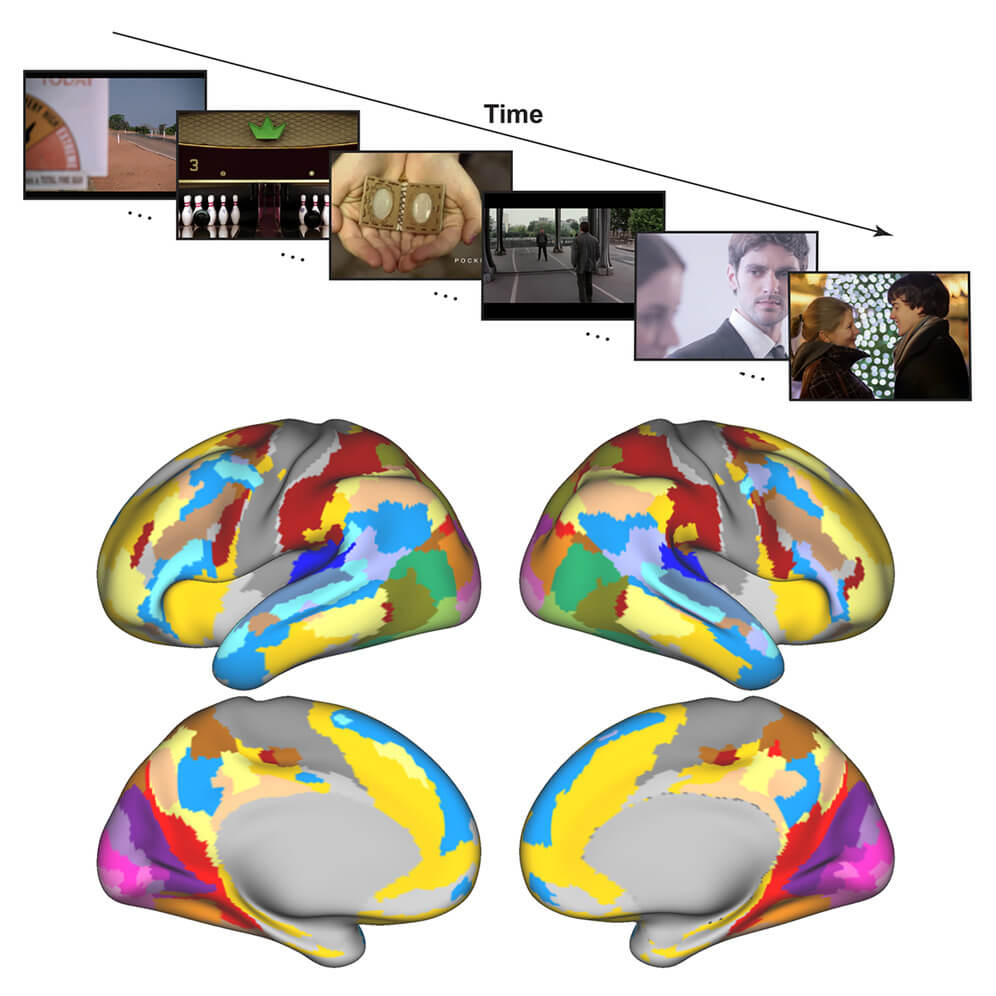
The research team analyzed brain scans from 176 healthy young adults (106 women and 70 men, aged 22-35) as they watched 60 minutes of movie clips from various films, including “Inception,” “The Social Network,” and “Home Alone.” Using a powerful 7-Tesla MRI scanner, the researchers captured detailed images of brain activity every second while participants viewed the films.
One of the study’s most significant findings was the discovery of a “push-pull” relationship between different types of brain networks. When scenes were easy to follow – like a clear conversation between characters – regions specialized for specific tasks (such as language processing) became very active. However, when scenes became more complex or ambiguous, requiring more cognitive effort to understand, these specialized regions would decrease their activity, while general executive control regions – areas responsible for problem-solving and information processing – would increase their activity.
The researchers used advanced computational techniques to identify 24 distinct functional networks in the brain’s outer layer (the cerebral cortex). Each network showed preferences for different types of movie content. Some networks responded strongly to human faces and bodies, others to movement or places and landmarks, and still others to interactions between humans and objects or social interactions between people.
The study also revealed that executive control networks – regions that help us plan, solve problems, and prioritize information – showed unique responses during unexpected transitions, such as when movie clips suddenly ended.
These findings could have implications for understanding various neurological and psychiatric conditions. By establishing how these brain networks typically interact during natural experiences, scientists might better understand what happens in conditions where this coordination is disrupted.
“In future studies, we can look at the maps of individual subjects, which would allow us to relate the individualized map of each subject to the behavioral profile of that subject,” says Rajimehr.
His team is now studying how specific content in movie frames drives these networks, including semantic and social context, and the relationship between people and background scenes.
Paper Summary
Methodology
The study used high-resolution 7T fMRI scanning to measure brain activity while participants watched various movie clips. The researchers averaged the brain activity patterns across all 176 participants. They then used a technique called hierarchical clustering to group brain regions that showed similar patterns of activity over time. This approach revealed 24 distinct functional networks in the brain, each responding to different aspects of the movie-watching experience.
Key Results
The study identified several key findings: 1) The brain organizes itself into 24 distinct functional networks during movie watching, 2) These networks show a “push-pull” interaction where some become more active while others become less active, 3) Different networks prefer different types of content (e.g., human-object interactions vs. human-human interactions), and 4) Executive control networks show unique responses to unexpected transitions.
Study Limitations
The study focused on young, healthy adults, so the findings might not generalize to other age groups or people with neurological conditions. The research also relied on averaging brain activity across participants, which might mask individual differences in how people process movies.
Discussion & Takeaways
This research provides a comprehensive map of how our brains process complex, real-world experiences. The discovery of the “push-pull” interaction between different brain networks suggests that the brain adapts its activity patterns based on the complexity and nature of the information it’s processing.
Funding & Disclosures
The research was supported by the McGovern Institute for Brain Research, the Cognitive Science and Technology Council of Iran, the MRC Cognition and Brain Sciences Unit, and a Cambridge Trust scholarship. The authors declared no competing interests.


