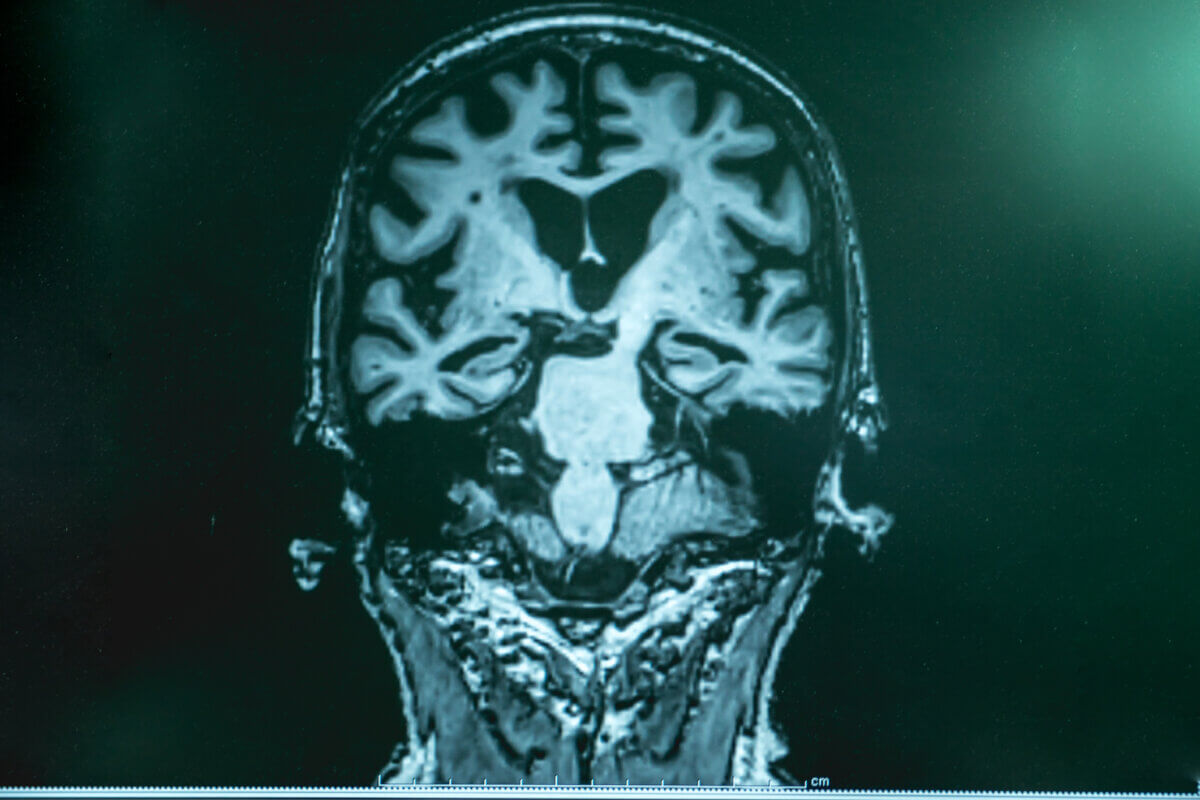
MRI of Alzheimer's dementia patient's brain. (Credit: © Atthapon Raksthaput | Dreamstime.com)
Brain’s immune cells literally devour nerve fibers that control scent detection, researchers show
In A Nutshell
- In an Alzheimer’s mouse model, immune cells called microglia target and remove norepinephrine-carrying nerve fibers in the olfactory bulb months before amyloid plaques appear.
- This early fiber loss leads to measurable smell deficits and happens before damage to other brain regions.
- Removing a microglial protein (TSPO) prevented fiber loss and preserved smell function in the mice.
- Human brain tissue and brain scans confirmed fiber loss and increased microglia presence in the olfactory bulb in early Alzheimer’s, suggesting smell testing and imaging could aid early detection.
MUNICH — Most people think Alzheimer’s disease begins with forgotten names or misplaced keys. But years before memory problems appear, many future patients lose something else entirely: their sense of smell. Scientists have now identified a biological explanation for this early warning sign: the brain’s own immune system targets and removes the nerve fibers responsible for processing scents.
New research published in Nature Communications reveals that specialized immune cells called microglia recognize and engulf nerve fibers from a brain region that sends chemical signals to our smell-processing center. This process begins in the study’s Alzheimer’s mouse model months before amyloid plaques, one of the hallmark features of the disease, appear.
Led by Dr. Lars Prager and Prof. Dr. Jochen Herm from the German Center for Neurodegenerative Diseases, the researchers note that this finding could help in developing early screening tools. In the future, a simple smell test might be used to help detect the earliest stages of brain changes linked to Alzheimer’s, long before memory loss occurs.

How Brain Immune Cells Cause Early Alzheimer’s Damage
Scientists used mice engineered to develop Alzheimer’s-like symptoms (AppNL-G-F mice). These rodents carry three genetic mutations that lead to elevated levels of toxic amyloid-beta protein, mimicking processes seen in human Alzheimer’s disease.
The team examined multiple brain regions to determine when and where nerve damage first occurred. They found that nerve fibers from the locus coeruleus, a small brain region that produces the chemical messenger norepinephrine, began degenerating exclusively in the olfactory bulb (the smell-processing center) between 1 and 2 months of age.
At two months, fiber loss was 14%. This increased to 27% by three months and 33% by six months. Other brain regions, such as the hippocampus and prefrontal cortex, remained unaffected until later in the disease course. The team confirmed that cholinergic and serotonergic fibers in the olfactory bulb were intact at this early stage.
Using imaging techniques, researchers observed microglia physically engulfing these nerve fibers. Normally, microglia help clean up debris and fight infection, but in these mice, they were actively removing living nerve connections. In laboratory tests, microglia from affected mice showed 33% greater uptake of labeled brain material than those from healthy mice after 12 hours.
Researchers Successfully Block Alzheimer’s-Related Smell Loss
The researchers identified a chemical signal driving this process. A molecule called phosphatidylserine, which acts as an “eat me” tag on dying cells, was found on the surface of the affected nerve fibers. This signal attracts microglia and prompts them to remove the marked tissue.
Nerve cells in the affected mice were unusually active, firing electrical impulses more frequently than normal. The authors propose that this overactivity causes phosphatidylserine to flip to the outside of the cell membrane, flagging the fibers for removal.
To test whether the process could be stopped, the team bred the Alzheimer’s-model mice with animals lacking a protein called TSPO, which microglia use in this phagocytosis process. These modified mice retained their nerve fibers and performed just as well as healthy mice on smell tests. This demonstrates that, at least in this model, early nerve loss in the olfactory bulb is preventable.
Human Studies Confirm Link Between Smell Loss and Alzheimer’s
The researchers also looked for signs of this phenomenon in people. Post-mortem brain tissue from individuals with early-stage Alzheimer’s showed a clear reduction in norepinephrine-producing fibers in the olfactory bulb compared to healthy, age-matched controls.
In living patients, the team used TSPO-PET brain scans, which detect increased numbers of immune cells, and found elevated signals in the olfactory bulbs of those with mild cognitive impairment, a potential precursor to Alzheimer’s dementia. These increases were not significantly higher in people already diagnosed with Alzheimer’s, suggesting the change occurs early.
Patients with Alzheimer’s scored lower on smell identification tests than healthy participants and those with mild cognitive impairment. The study included 23 individuals in the brain tissue analysis and 46 participants in the imaging studies.

Simple Smell Tests Could Detect Alzheimer’s Years Earlier
The nerve damage was specific to the norepinephrine system: no early loss of acetylcholine- or serotonin-producing fibers was found. This could help explain why smell loss in Alzheimer’s differs from that in other diseases like Parkinson’s, where sensory neurons in the nose are affected.
The observation that immune cell activity in the olfactory bulb rises and then levels off suggests there may be a treatment window in the earliest stages, before widespread brain regions are affected.
Rather than simply responding to damage, the brain’s immune cells in this case appear to be directly involved in removing functioning nerve fibers. The process begins with our oldest sense — smell — and only later progresses to brain regions responsible for memory and higher thinking.
Disclaimer: This summary is for informational purposes only and is not a substitute for professional medical advice, diagnosis, or treatment. Always seek the guidance of a qualified healthcare provider with any questions regarding Alzheimer’s disease or other medical conditions.
Paper Summary
Methodology
Researchers used genetically modified mice (AppNL-G-F) and compared them to healthy controls from 1 to 12 months of age. Methods included immunostaining to visualize nerve fibers, RNA sequencing of microglia, electrophysiology to measure nerve activity, and behavioral smell tests. For human validation, the team examined olfactory bulb tissue from 23 deceased individuals and performed TSPO-PET scans and smell tests in 46 living participants.
Results
- Norepinephrine fibers from the locus coeruleus to the olfactory bulb began degenerating at 2 months in mice (14% loss at 2 months, 33% at 6 months).
- This occurred before amyloid plaques appeared and before degeneration in other brain regions.
- Microglia showed increased phagocytic activity toward fibers marked with phosphatidylserine.
- Removing the TSPO protein prevented both fiber loss and smell deficits.
- Human studies confirmed fiber loss in early Alzheimer’s and elevated immune cell presence in the olfactory bulb.
Limitations
Relies on one mouse model and a relatively small number of human tissue samples. Human post-mortem analysis cannot show the progression over time, and the imaging cohort size was modest.
Funding & Disclosures
Supported by the Deutsche Forschungsgemeinschaft, Munich Cluster for Systems Neurology, German Centre for Neurodegenerative Diseases, and other European funding bodies. One author reported consulting fees from pharmaceutical companies; no other competing interests declared.
Publication Info
“Early Locus Coeruleus noradrenergic axon loss drives olfactory dysfunction in Alzheimer’s disease,” Nature Communications, Vol. 16, Article 7338 (2025). Lead author: Carolin Meyer; senior authors: Jochen Herms and Lars Paeger.


