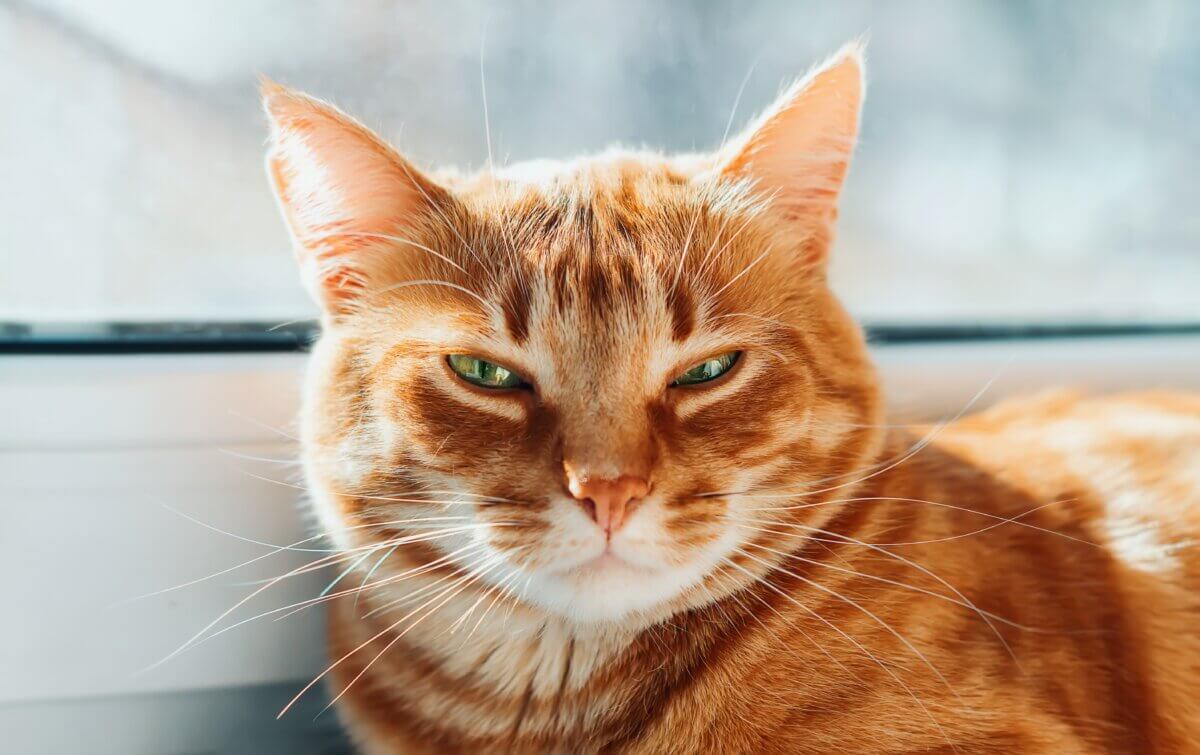
Why are orange cats orange? (Natallia Mikulich/Shutterstock)
In a nutshell
- Scientists have identified a specific 5,100-letter DNA deletion in the ARHGAP36 gene on the X chromosome that causes orange fur in cats, solving a genetic mystery that has puzzled researchers for over 60 years.
- This mutation explains why almost all tortoiseshell and calico cats are female. The orange gene is X-linked and subject to random X chromosome inactivation, which produces the signature patchwork of fur colors.
- The deleted DNA segment includes a crucial regulatory element that likely causes ARHGAP36 to become overactive, shifting pigment production from black-brown eumelanin to orange-red pheomelanin in certain skin cells.
FUKUOKA, Japan — What makes orange cats orange? For over 60 years, scientists have been searching for the answer. Now, researchers from Japan have figured it out, and their discovery also explains why almost all tortoiseshell and calico cats are female.
The study results, published in Current Biology, centers on a gene called ARHGAP36, located on the X chromosome. When a specific chunk of DNA goes missing from this gene, cats turn orange. Since male cats only have one X chromosome, they’re either orange or not orange. But female cats, with two X chromosomes, create the stunning patchwork patterns of tortoiseshell and calico cats, a living display of genetics at work.
“Identifying the gene has been a longtime dream, so it’s a joy to have finally cracked it,” says lead study author Hiroyuki Sasaki from Kyushu University, in a statement.

Sasaki is a a self-proclaimed cat-lover, which may explain his fascination with feline genealogy. In female mammals, one of the two X chromosomes randomly shuts down in each cell during early development. British geneticist Mary Lyon first proposed this idea in 1961, using tortoiseshell cats as her prime example. Now, scientists have finally identified the actual gene responsible.
The Orange Gene
Research teams have been searching for the orange gene for decades, knowing it was somewhere on the X chromosome but unable to pinpoint its exact location. Sasaki’s team, working with colleagues across Japan, examined DNA from 58 cats with varying coat colors. They focused on a specific region of the X chromosome where previous studies had narrowed down the location of the mysterious orange gene.
After closely examine cat DNA, the researchers found that every single orange cat in their study was missing the same 5,100-letter chunk of genetic code from the ARHGAP36 gene. Every non-orange cat had this section intact.
To confirm their findings, they expanded their analysis to include data from 258 cats contributed by the 99 Lives Cat Genome Sequencing Initiative, including cats from the United States, Europe, and the Middle East. The pattern held: the deletion was present in all cats with orange coloring and absent in all cats without it.
Most scientists expected the orange gene to be directly involved in pigment production. ARHGAP36 was not an obvious candidate. This gene codes for a protein that helps regulate several cellular processes, including pathways involved in hair follicle development and melanin production, the pigments that give hair its color.

“This is key,” says Sasaki. “ARHGAP36 is essential for development, with many other roles in the body, so I had never imagined it could be the orange gene. Mutations to the protein structure would likely be harmful to the cat.”
Instead of damaging the protein itself, the deletion removes a regulatory switch, a piece of DNA that normally controls when and where ARHGAP36 is active. When the researchers looked at skin tissue from orange patches versus black-brown patches on the same calico cat, they found ARHGAP36 was much more active in the orange areas.
The deleted DNA region contains what scientists call an “ultraconserved element,” a stretch of genetic code that’s remained virtually unchanged across many species for millions of years. This suggests it plays a crucial regulatory role, like a genetic on-off switch that evolution has preserved because it’s so important.
The researchers discovered that when this regulatory element is missing, ARHGAP36 becomes overactive in certain skin cells. This overactivity appears to suppress genes involved in producing eumelanin (black-brown pigment) while promoting pheomelanin (orange-red pigment). When ARHGAP36 goes into overdrive, it essentially flips switches to produce orange coloring instead.
Why Are Certain Cats Always Female?
The study also helps to explain why tortoiseshell and calico cats are almost always female. Since the orange gene sits on the X chromosome, male cats (XY) can only be orange or not orange. But female cats (XX) can have one orange X chromosome and one non-orange X chromosome.

During early development, each cell in a female kitten randomly inactivates one of its X chromosomes. Cells that silence the non-orange X chromosome will grow orange fur, while cells that silence the orange X chromosome will grow black or brown fur. This creates the distinctive patches that make tortoiseshell and calico cats so striking.
The rare male tortoiseshell cats that exist typically have an extra X chromosome (XXY), a genetic condition that allows them to display the patchwork pattern.
Perhaps most surprisingly, the researchers found that all orange cats appear to share the same ancestral deletion. Rather than orange coloring arising independently in different cat populations, this suggests all orange cats descended from a single ancestor who first carried this genetic change.
Earlier theories proposed multiple origins for orange cats. Instead, it appears that somewhere in history, one cat developed this deletion, and over thousands of years, it spread throughout domestic cat populations worldwide through breeding.
ARHGAP36 exists in many mammals, including humans and mice, but this particular role in coat color appears unique to cats. When researchers tried to recreate the orange coloring in mice by deleting the same genetic regions, nothing happened. In humans, ARHGAP36 is linked to skin conditions and hair follicle development.
Sasaki’s team is far from finished. They’re planning ambitious research projects that could trace the history of orange cats back thousands of years.
“One idea is to study ancient Egyptian cat paintings—or even to test DNA from mummified cats—to see if any cats back then were orange,” adds Sasaki. “It’s ambitious, but I’m excited to try.”
The researchers are also interested in exploring potential connections between coat color and behavior, a topic that fascinates many cat owners.
“Many cat owners swear by the idea that different coat colors and patterns are linked with different personalities,” says Sasaki. “There’s no scientific evidence for this yet, but it’s an intriguing idea and one I’d love to explore further.”
Scientists still don’t fully understand exactly how the missing DNA leads to the switch from black pigment to orange pigment. The researchers suspect the deletion disrupts normal gene regulation, causing ARHGAP36 to be active when it shouldn’t be, but the precise molecular process needs more investigation.
The researchers hope to use emerging technologies like cat stem cells to create laboratory models that could help answer these remaining questions. They’re particularly interested in understanding how random X chromosome inactivation creates the specific patterns seen in tortoiseshell and calico cats.
Scientists have finally identified the genetic switch that transforms house cats into living displays of cellular biology. Every orange tabby and patchwork calico serves as a walking, purring example of how genes and chromosomes work together to create the beautiful fur coats pet owners have come to love so much.
Paper Summary
Methodology
Researchers analyzed DNA from 58 domestic cats of various colors using whole genome sequencing to read their complete genetic code. They focused on a 1.5-megabase region of the X chromosome previously linked to orange coloring. The team used polymerase chain reaction (PCR) to confirm specific genetic deletions and performed RNA sequencing on skin tissues from different colored patches of calico cats to measure gene activity. They also analyzed DNA methylation patterns to understand how X chromosome inactivation affects gene expression. The study was expanded using publicly available genetic data from 258 additional cats from the 99 Lives Cat Genome Sequencing Initiative.
Results
Every orange cat studied carried a 5,076-nucleotide deletion within the ARHGAP36 gene on the X chromosome, while no non-orange cats had this deletion. This deletion removes a highly conserved regulatory DNA sequence that normally controls ARHGAP36 expression. In orange fur patches, ARHGAP36 was overexpressed and negatively correlated with many melanogenesis (pigment production) genes. The deletion appears to shift pigment production from eumelanin (black-brown) to pheomelanin (orange-red). Evidence suggests this gene undergoes random X chromosome inactivation in female cats, explaining the patchy patterns in tortoiseshell and calico cats. All orange cats appear to share this same deletion, suggesting a single evolutionary origin.
Limitations
The study couldn’t directly prove causation in live cats since genetic modification experiments aren’t feasible in companion animals. Attempts to recreate orange coloring in mice by introducing similar deletions were unsuccessful, suggesting this mechanism may be cat-specific. The research was limited to skin tissue analysis and couldn’t examine melanocytes directly. The exact molecular mechanism by which the deletion shifts pigment production from eumelanin to pheomelanin remains unclear. Sample sizes varied between analyses, with some methylation studies using only single animals.
Funding and Disclosures
This research was partly supported by 619 crowdfunding backers on the READYFOR platform. The authors declared no competing interests. Specific institutional funding came from Kyushu University’s Medical Institute of Bioregulation and associated research organizations.
Publication Information
The paper, “A deletion at the X-linked ARHGAP36 gene locus is associated with the orange coloration of tortoiseshell and calico cats,” was authored by Toh, H., Au Yeung, W.K., Unoki, M., et al. It was published in Current Biology (Volume 35, Pages 1-10) on May 15, 2025.


