
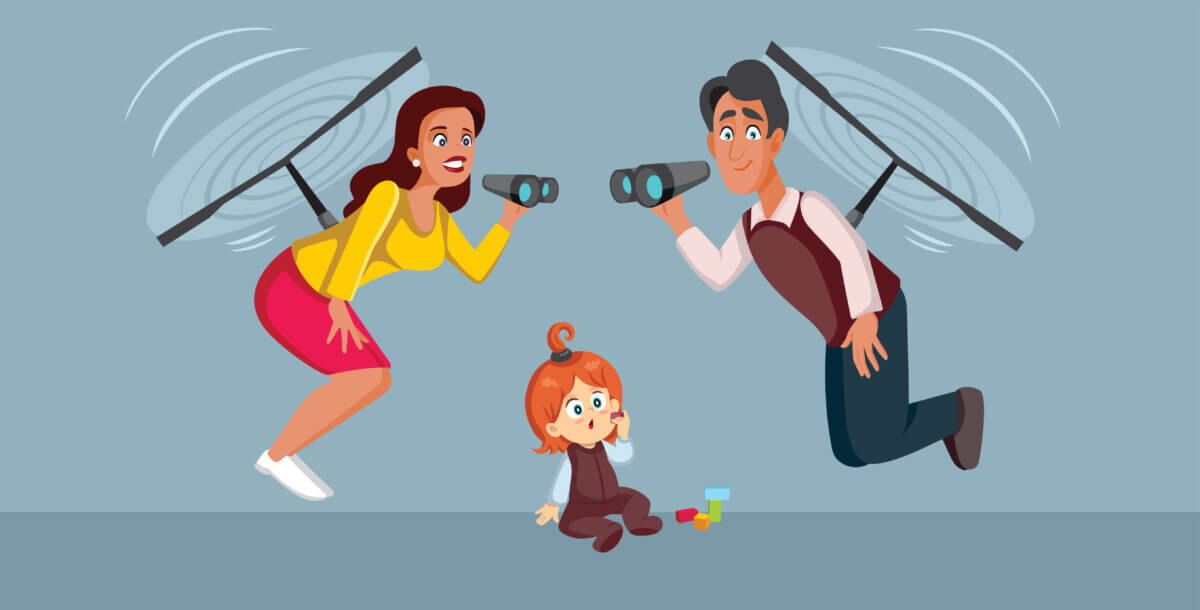
Helicopter parents may not be preparing their child for independence when they leave for college. (Photo by My Agency on Shutterstock)
In A Nutshell
- First-year college students with overprotective (“helicopter”) parents reported significantly more anxiety when faced with common stressors.
- The effect wasn’t due to general parenting quality: parental warmth and care did not buffer students from stress-related anxiety.
- Overprotective parenting may hinder the development of coping skills and emotional regulation, leaving students more vulnerable during the transition to independence.
- The study highlights the importance of balanced parenting: providing support while allowing children to face age-appropriate challenges.
MONTREAL — Parents who constantly monitor and control their children’s lives may be setting them up for a mental health crisis in college. New research from McGill University shows that students with overprotective parents experience dramatically higher anxiety levels when facing typical university stressors, while their peers with less controlling parents handle identical challenges with much greater ease.
How Helicopter Parenting Amplifies Stress
Research published in Development and Psychopathology examined exactly how childhood parenting styles interact with college stress to predict anxiety levels. The study, conducted by researchers from McGill University’s Department of Psychology and UCLA’s Department of Psychiatry and Biobehavioral Sciences, tracked 240 first-year college students through their transition to university life.
The researchers found that “higher levels of stressor exposure would be associated with more anxiety symptoms during the transition to college, but that this association would be moderated by parenting experiences.” Their hypothesis proved correct, but with a concerning twist.
Students completed detailed assessments measuring two distinct aspects of their upbringing: parental care (warmth, affection, and responsiveness) and parental overprotection (excessive control, intrusion, and prevention of independence). They also reported specific stressors encountered during their first months of college and completed anxiety assessments covering panic, social anxiety, and other symptoms.
The study measured actual stressful events rather than just perceived stress levels, which can be influenced by current mood and anxiety. Using the Stress and Adversity Inventory for Adults, researchers counted 14 different types of stressors students might face when starting college, from housing problems to academic pressures to personal losses.
When Protection Becomes Vulnerability
The results exposed a troubling interaction pattern. The study found “a significant interaction between parental overprotection and stressor exposure, such that higher parental overprotection and higher levels of recent stressor exposure were associated with more anxiety symptoms.”
Students whose parents had been highly overprotective during childhood showed steep increases in anxiety as college stressors accumulated. Each additional challenge triggered significantly more distress in these students compared to their peers with less controlling parents. The mathematical relationship was stark: students with the most overprotective backgrounds experienced anxiety levels that climbed sharply with each new stressor, while those with less controlling parents showed little change in anxiety regardless of how many challenges they faced.
The study’s 240 participants averaged 18.2 years old, with 75% female representation. Students came from diverse backgrounds, with 51.7% identifying as White, 32.9% as Asian or Asian Canadian, and others representing various racial and ethnic groups. Family incomes ranged widely, with the median falling between $150,000 to $199,000 (Canadian dollars), though the range extended from less than $10,000 to over $250,000.
The Overprotection Trap
The researchers explain that parental overprotection can include practices like guilt, coercion, and micromanagement. These behaviors have been linked to increased anxiety symptoms throughout people’s lives, not just during childhood. The pattern appears to persist well into young adulthood, particularly during stressful transitions like starting college.
Students with helicopter parents may reach college without crucial coping skills that develop through handling challenges independently. When parents constantly intervene to prevent difficulties, solve problems, or shield children from consequences, those children miss opportunities to build confidence in their own problem-solving abilities. College often represents the first major test of independent coping, and overprotected students frequently discover they lack the internal resources their peers developed through earlier challenges.
The researchers propose several mechanisms for this vulnerability. One possibility involves attachment patterns that form during childhood and persist into adulthood. Overprotective parenting often leads to insecure attachment styles, which research suggests remain stable throughout adulthood. This can affect adult social interactions and contribute to increased anxiety during the transition to university, where many new social connections are made.
Another explanation centers on emotional regulation skills. The authors note that overprotective parenting can result in “poorer learned emotion regulation and coping skills” which “can last into adulthood” and lead to “greater distress in response to stressors.” Without these internal tools, college students may feel overwhelmed by challenges that their peers handle with relative ease.
The College Mental Health Crisis Context
The researchers emphasize that the first year of university represents a developmentally significant transition involving substantial stressor exposure and increased independence. For some students, this period brings heightened anxiety, while others navigate the challenges more successfully. Understanding this variation became a key focus of the research.
Previous studies have shown that first-year students typically report higher anxiety levels than upperclassmen, but not all struggle equally. This difference led researchers to investigate what makes some students more vulnerable than others during the college transition. The answer appears to lie partly in their childhood experiences with parental control and independence.
The study used well-established psychological instruments to ensure accuracy. Students completed the Parental Bonding Instrument, rating their parents’ behaviors during their first 16 years of life on multiple dimensions including care and overprotection. The anxiety assessment drew from eight different subscales of the Inventory of Depression and Anxiety Symptoms, creating a composite score that covered panic, social anxiety, claustrophobia, traumatic intrusions and avoidance, checking, ordering, and cleaning behaviors with high internal consistency.

Real-World Applications and Study Limitations
The research methodology had both strengths and limitations that affect how we interpret the results. The researchers acknowledge they “did not collect information about parental anxiety” which could influence both parenting styles and children’s genetic vulnerability to anxiety disorders. Parents with anxiety might be more likely to engage in overprotective behaviors while also passing along genetic predispositions to anxiety.
The study also used retrospective self-reports covering parenting behaviors from birth through age 16. This approach doesn’t account for how parenting might change as children develop, and some behaviors that are appropriate for young children might become overprotective as kids get older. Students might also have difficulty accurately recalling or averaging parenting behaviors across such a long developmental period.
Additionally, the study didn’t assess students’ anxiety levels before they started college, making it impossible to determine whether the observed differences developed during the college transition or existed beforehand. The cross-sectional design also prevents researchers from determining whether overprotective parenting directly causes vulnerability or whether anxious children prompt more protective parenting behaviors from concerned parents.
The researchers note that anxiety during early life stages and parenting styles have a bidirectional association, meaning parents tend to be more overcontrolling with anxious children, which may result in more anxiety in adulthood. They suggest that dynamic and longitudinal study designs would be useful in understanding the mechanisms of this effect.
Despite these limitations, the interaction pattern provides valuable insights into how childhood experiences might shape responses to adult stressors. The findings are consistent with theories about how parenting affects the development of coping skills and emotional regulation abilities.
Breaking the Cycle Before College
This research represents part of a larger longitudinal study at McGill University examining various aspects of mental health during the college transition. The work adds to growing evidence that helicopter parenting, despite arising from love and good intentions, may create vulnerabilities during crucial developmental periods when young people need to develop independence and self-reliance.
Researchers suggest that future studies should examine attachment styles and emotion regulation skills as potential mechanisms underlying these effects. They also recommend longitudinal research that can better establish causal relationships and track how parenting effects unfold over time, particularly examining whether parenting styles can predict changes in symptoms before and after stressors.
For parents, gradually allowing children to face age-appropriate challenges and develop their own coping strategies might better prepare them for the inevitable stresses of adult life. The goal isn’t to eliminate parental involvement or support, but to find the right balance between protection and independence that builds resilience rather than dependence. For colleges, understanding which students might be more vulnerable to stress could help target support services more effectively during this critical transition period.
Disclaimer: This article is based on findings from a peer-reviewed study. The research identifies associations between parenting styles, college stressors, and anxiety symptoms, but it does not prove direct causation. Readers should not interpret these results as a substitute for medical or psychological advice. If you or someone you know is struggling with anxiety, please seek guidance from a qualified mental health professional.
Paper Summary
Methodology
This study examined 240 first-year undergraduate students at McGill University, with an average age of 18.2 years. Participants completed questionnaires measuring parenting behaviors they experienced during their first 16 years of life, stressors they encountered during their transition to university, and their current anxiety symptoms. Researchers used the Parental Bonding Instrument to assess both parental care and overprotection, the Stress and Adversity Inventory for Adults to count recent stressors, and the Inventory of Depression and Anxiety Symptoms to measure anxiety levels. The study used statistical modeling to examine how parenting characteristics interacted with stressor exposure to predict anxiety symptoms.
Results
The study found a significant interaction between parental overprotection and stressor exposure, with higher parental overprotection and higher levels of recent stressor exposure associated with more anxiety symptoms. This effect was strongest for students reporting moderate to high levels of parental overprotection. For students with less overprotective parents, experiencing multiple college stressors didn’t significantly increase anxiety. Parental care didn’t significantly moderate the relationship between stress and anxiety in this college-age sample.
Limitations
The study used retrospective self-reports of parenting behaviors covering a broad age range (0-16 years), which may not capture changes in parenting over time. Researchers didn’t collect information about parental anxiety, which could influence both parenting style and children’s genetic vulnerability to anxiety. The cross-sectional design prevents determining causation, and the study didn’t assess students’ anxiety levels before college. The sample was predominantly female (75%) and the results may not generalize to other populations.
Funding and Disclosures
The research was supported by funds from the Canada Research Chair in Clinical Neuroscience, CIHR, the California Governor’s Office of Planning and Research/California Initiative to Advance Precision Medicine, and the California Department of Health Care Services. The authors declared no conflicts of interest with respect to this work.
Publication Information
The study was published in Development and Psychopathology in 2025. The research was conducted by Lidia Y.X. Panier and colleagues from McGill University’s Department of Psychology and UCLA’s Department of Psychiatry and Biobehavioral Sciences. The paper was received in November 2024, revised in May 2025, and accepted in May 2025.


