
(Credit: Lorenzooooo/Shutterstock)
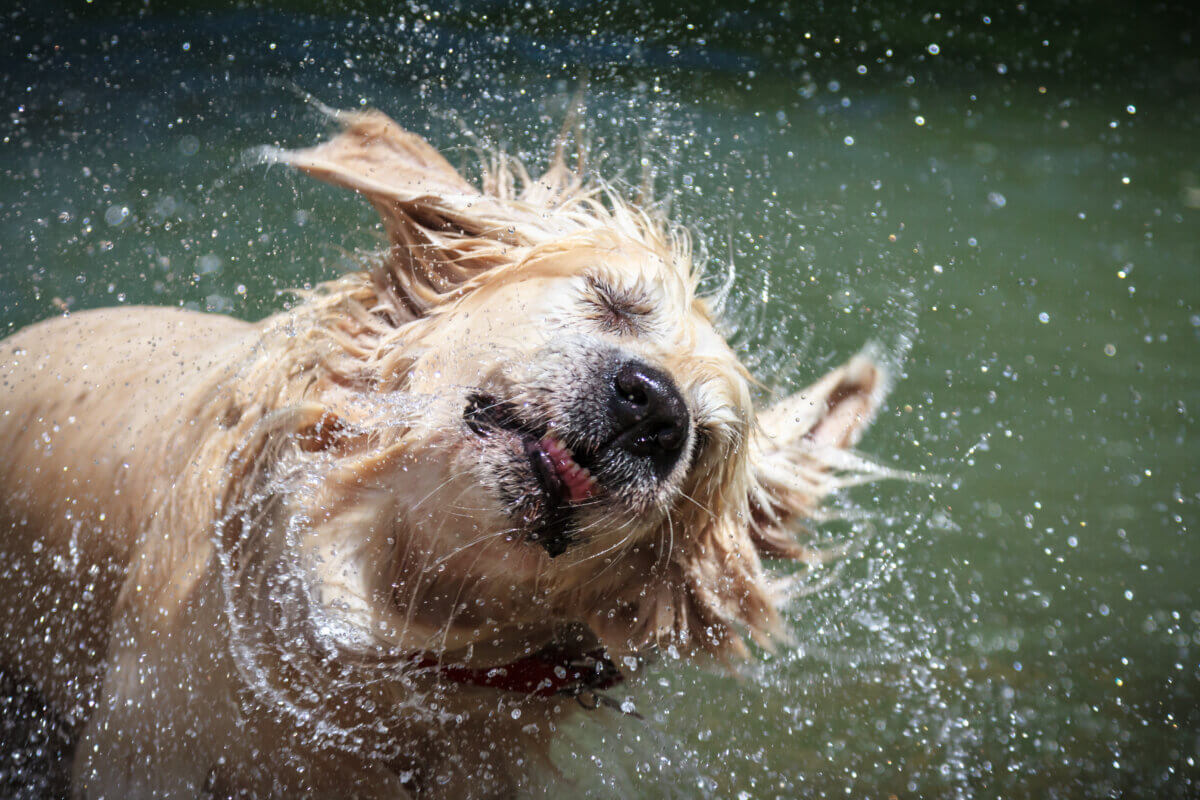
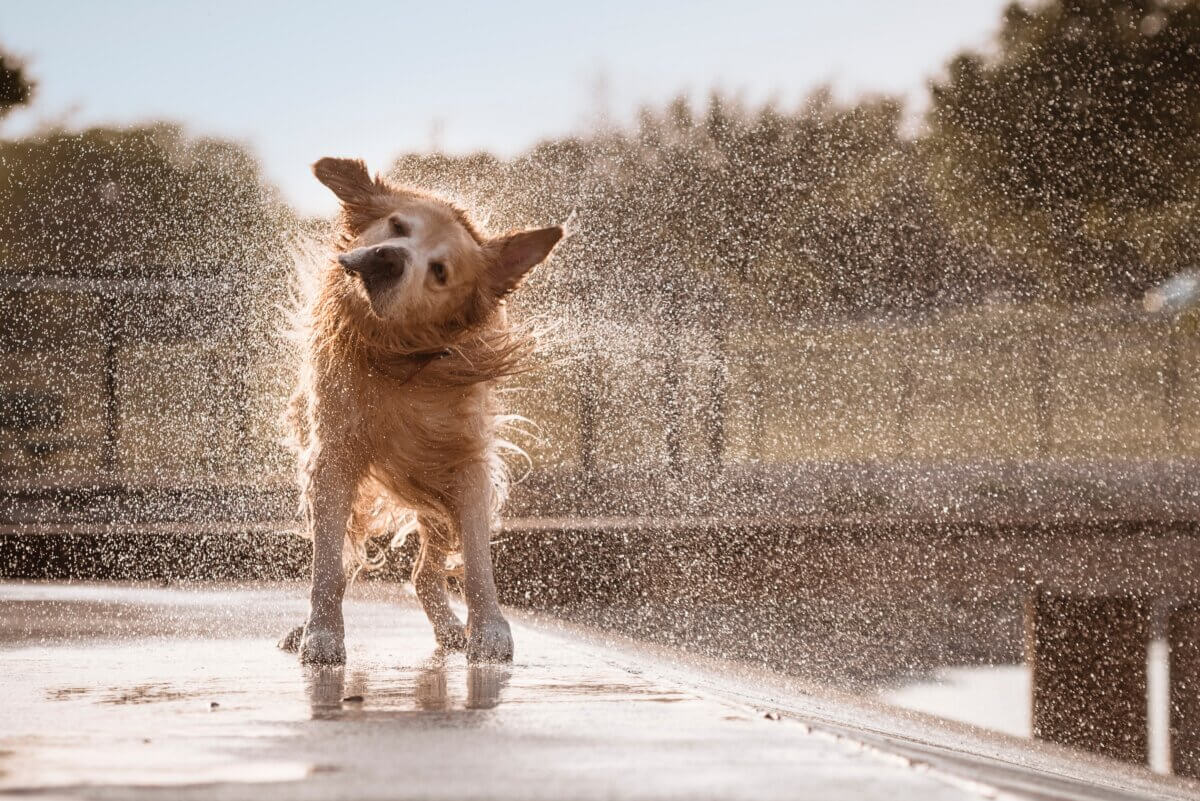
BOSTON — We’ve all seen it – that characteristic full-body shimmy that dogs do after getting wet, sending water droplets flying in all directions. The “wet dog shake” isn’t just limited to our canine companions, though. It’s actually an evolutionarily conserved behavior observed widely across hairy mammalian species. Now, scientists have finally uncovered the precise neural circuitry that triggers this peculiar but essential behavior.
In a new study published in Science, researchers at Harvard Medical School have mapped out the specific sensory neurons and brain pathways responsible for initiating these rapid oscillations that help animals shed water and other irritants from their fur. The discovery not only helps explain a ubiquitous animal behavior but also provides fascinating insights into how our nervous systems process touch sensations and transform them into coordinated motor responses.
The wet dog shake serves as a highly efficient way to rapidly remove water and other substances from an animal’s fur, particularly from areas like the back where they can’t easily reach to groom themselves. The research team used a variety of sophisticated techniques to identify the specific nerve cells that detect water or oil droplets on the skin and trigger the characteristic shaking response. Their research focused on mice, which exhibit this same shaking behavior.
Led by neuroscientist Dawei Zhang, the study explains that the key players are specialized touch-sensing neurons called C-LTMRs (C-fiber low-threshold mechanoreceptors). These neurons are exquisitely sensitive to gentle mechanical stimulation and are found exclusively around the small, fine hairs that make up animals’ undercoat. When water or oil droplets land on the fur, they cause these tiny hairs to move, which activates the C-LTMR neurons.
To prove these neurons were indeed responsible for triggering the shake response, the researchers used a technique called optogenetics, which allows them to activate specific neurons using light. When they stimulated just the C-LTMR neurons with light, the mice performed the characteristic shaking behavior – even though no water or oil was present. It was as if they had fooled the mouse’s nervous system into thinking it was wet.
The team also performed the reverse experiment: they selectively eliminated the C-LTMR neurons and found that mice with fewer of these neurons showed a roughly 50% reduction in their shaking response when water or oil was applied to their fur. This confirmed that these specific neurons play a crucial role in detecting the presence of substances in the fur and initiating the shake response.
Researchers also mapped out the neural pathway that carries this information to the brain. They discovered that the C-LTMR neurons connect to a specific group of neurons in the spinal cord, which then relay the information to a brain region called the lateral parabrachial nucleus. When this pathway was interrupted in their experiments, the shaking response was significantly reduced.
The precision of this system is remarkable. The shaking behavior is highly stereotyped, meaning it looks nearly identical each time it’s performed. In mice, each shake involves about three full back-and-forth rotations of the body at a frequency of approximately 19 Hz (or 19 times per second). This consistency suggests the existence of a dedicated neural circuit that produces this specific motor pattern.
Interestingly, the researchers found that this shaking response was most robust when stimuli were applied to the back of the neck, less so when applied to the lower back, and nonexistent when applied to the thigh. This matches with the areas that are hardest for animals to reach through normal grooming behaviors.
The study also revealed that this same neural circuit appears to be activated by various other stimuli beyond just water, including air puffs and certain chemicals. This suggests that the wet dog shake serves as a general-purpose defensive behavior to remove potentially irritating substances from an animal’s fur.
Perhaps most fascinating is the realization that these C-LTMR neurons, which previous research had suggested might be involved in touch sensations, actually serve a clear practical purpose in detecting substances on the fur. These neurons appear to be part of a specialized sensory system that helps maintain the cleanliness and functionality of an animal’s coat.
From neurons to water droplets, from spinal cord to synchronized oscillations, the wet dog shake represents a masterpiece of evolutionary engineering. Perhaps next time, evolution could work on adding a “splash guard” feature.
Paper Summary
Methodology
The researchers used a combination of genetic, behavioral, and physiological techniques to conduct their study. They worked primarily with mice, using various genetic tools to manipulate specific types of neurons. They created specialized mouse lines where they could either activate or eliminate specific neurons of interest. They tested the mice’s responses to different stimuli, including water, oil droplets, and air puffs, while measuring the frequency and characteristics of their shaking behavior. They also used sophisticated imaging techniques to watch neural activity in real-time and performed detailed electrical recordings from different types of neurons to understand how they communicate with each other.
Key Results
The study found that specialized touch-sensing neurons called C-LTMRs are crucial for initiating the wet dog shake response. When these neurons were activated artificially using light, it triggered the shaking behavior. When these neurons were eliminated, the shaking response was reduced by about 50%. The researchers also mapped out the complete neural pathway from these sensory neurons through the spinal cord to a specific region of the brain. They found that the shaking behavior was most pronounced when stimuli were applied to the neck region, and that each shake involved about three full body rotations at a frequency of 19 Hz.
Study Limitations
While this study provides compelling evidence for the role of C-LTMRs in the wet dog shake response, it was conducted primarily in mice, and further research would be needed to confirm if the exact same neural circuits are at work in other mammals. Additionally, while the researchers were able to reduce the shaking response by eliminating C-LTMRs, they couldn’t completely eliminate it, suggesting there might be other neural pathways involved that weren’t identified in this study.
Discussion & Takeaways
This research provides the first detailed understanding of how a common mammalian behavior is controlled at the neural circuit level. It shows how specialized sensory neurons can detect subtle mechanical stimuli and trigger a complex, coordinated motor response. The findings suggest that what we previously thought might be touch-sensing neurons actually serve a practical purpose in helping animals maintain their fur. This work could have broader implications for understanding how the nervous system transforms sensory information into motor commands.
Funding & Disclosures
The research was supported by NIH grant NS097344 and the Lefler Center for Neurodegenerative Disorders. Additionally, work was supported by NIH5P30EY012196 (to Boston Children’s Hospital Viral Core). Dr. David Ginty is an investigator with the Howard Hughes Medical Institute. The authors declared no competing interests.


