(Photo by Tero Vesalainen on Shutterstock)
In a nutshell
- Adding periods between words in text messages (like “We. Need. To. Talk.”) makes them feel more emotionally intense to readers
- Breaking messages into separate one-word texts has a similar emotional impact, but simply spacing words on different lines doesn’t have the same effect
- These punctuation patterns may work like dramatic pauses in speech, helping texters express emotion when they can’t use tone of voice or facial expressions
BINGHAMTON, N.Y. — Glance at these two text messages:
“we need to talk”
“We. Need. To. Talk.”
That shift in punctuation transforms a concerning message into something that feels decidedly more serious. According to new research from Binghamton University, this emotional intensification through punctuation isn’t just reader interpretation. It’s a documented psychological effect that changes how we understand digital messages.
The study, published in Frontiers in Psychology, reveals how specific punctuation patterns in text messages can dramatically alter their emotional impact. Led by psychologist Celia Klin and former graduate students Rachel Poirier and Andrew Cook, the research examined how periods between words and split-up messages affect readers’ emotional interpretation.
“Texters are much more limited than speakers in conveying important social and pragmatic information,” Klin says in a statement. When we talk face-to-face, we rely on tone of voice, facial expressions, and body language to understand true meaning. But texting strips away these natural cues, forcing people to find creative ways to express emotion through what researchers call “textisms” — everything from emojis to strategic punctuation.
Klin’s team had previously discovered that ending a single-word text with a period (like “whatever.” instead of “whatever”) makes messages feel more abrupt or insincere. This observation led them to investigate two other common texting patterns: putting periods between every word and breaking messages into separate text bubbles.
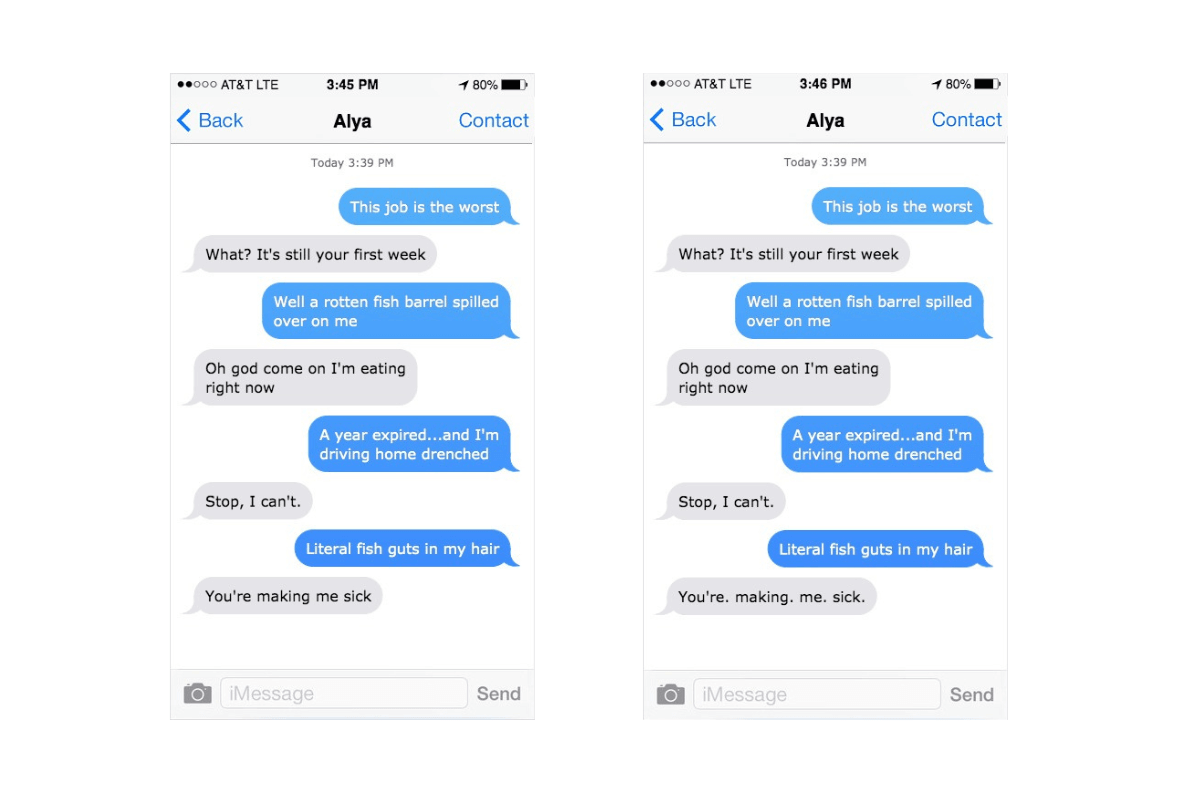
For their first experiment, they showed 80 college students various text conversations. Some messages had periods after each word (like “That. Was. Completely. Unacceptable.”), while others used standard formatting. Students rated how frustrated or disgusted they thought the texter felt on a scale from 1 to 7. Messages with periods between words consistently received higher emotional intensity ratings.
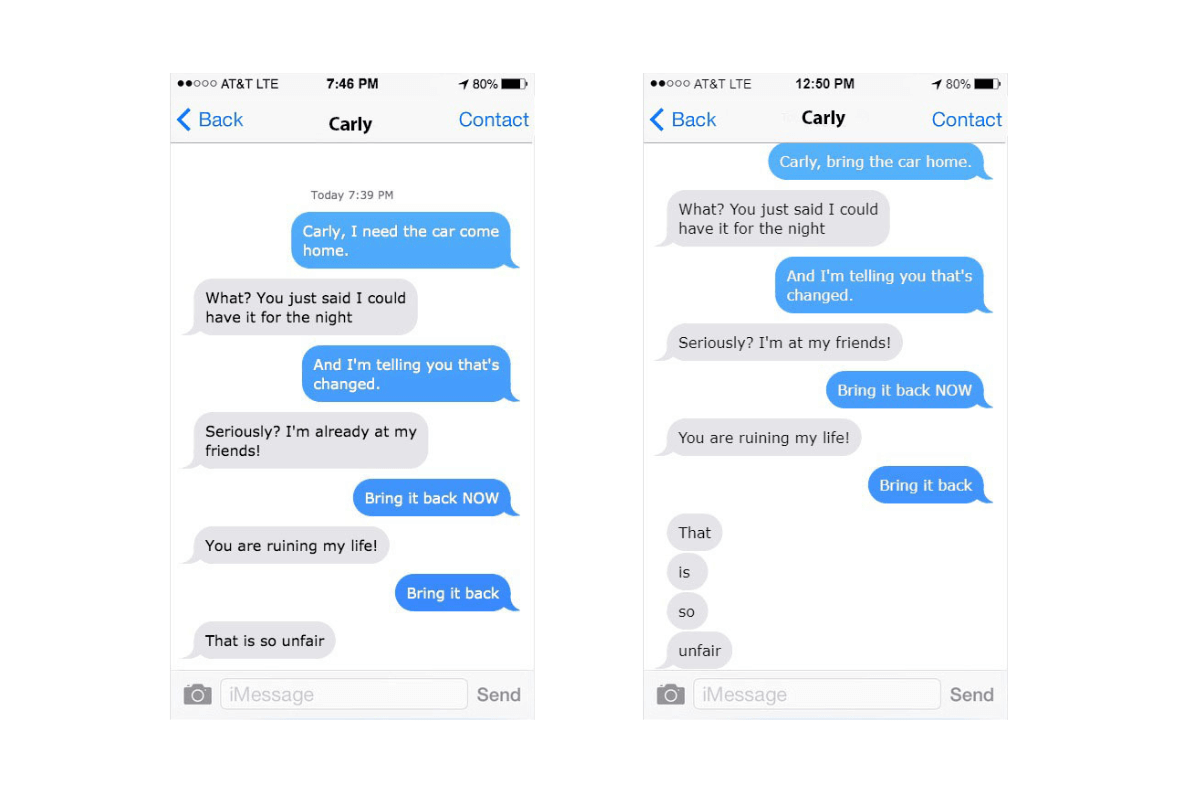
The second experiment explored whether splitting a message into separate texts had similar effects. Sixty participants viewed conversations where messages were either sent as individual words (like sending “Don’t” followed by “even” followed by “start”) or as complete sentences. The split-up messages were rated as more emotionally charged, just like the messages with extra periods.
Why do these simple punctuation choices pack such an emotional punch? Klin explains that readers assume these choices are deliberate and meaningful: “That is, they believe that the textisms were included to communicate meaning. This can be thought of with regard to the concept of ’emotion work’: Text recipients understand that the inclusion of textisms required work and assume this work was undertaken deliberately.”
To determine whether these effects came from just taking up more space on screen, the researchers conducted a third experiment with 78 participants. They showed messages either on single lines or with each word on its own line within the same text bubble. This time, there was no difference in emotional ratings, proving that it’s specifically the use of periods or separate bubbles that conveys feeling, not just visual spacing.
These findings help explain why texting has developed its own set of unwritten rules. Consider how a simple response like “fine” can transform into “That’s. Just. Fine.” when someone is clearly not fine at all. The period, once a simple way to end a sentence, now carries layers of additional meaning in digital communication.
The researchers suggest that both types of textisms might work by creating a pause effect in readers’ minds, similar to how someone might speak very deliberately when making an important point. “One can imagine that the presence of a period after each word was ‘heard’ by readers as a staccato speech: No. Just. Stop,” Klin explains. “The same can be argued for the second textism we examined, with words being read one at a time in individual text bubbles.”
However, Klin notes that more research is needed to fully understand how these textisms work in different contexts. The findings might be different in more formal situations, like messages between an employee and boss. The study also only looked at texts conveying negative emotions, so future research should examine a wider range of emotional expressions and consider how individual reader characteristics might affect interpretation.
Text-based communication now dominates many parts of our daily lives. A manager might notice the difference between receiving “sounds good” versus “Sounds. Good.” from an employee after announcing a new project. A friend’s “can’t wait” hits differently when it arrives as three separate messages: “can’t” “wait” “!!!”
The next time you receive a text broken into single words or filled with extra periods, pay attention. The sender has likely made a deliberate choice to emphasize their message through these digital tools.
Paper Summary
Methodology
The researchers conducted three separate experiments using undergraduate students from Binghamton University. Each experiment showed participants different versions of text message exchanges and asked them to rate the emotional intensity on a 7-point scale. The messages contained various emotions like frustration and disgust, with some featuring special punctuation patterns while others served as control versions without such formatting.
Results
All three experiments produced clear patterns. In the first experiment, adding periods between words significantly increased perceived emotional intensity, with an average rating difference of 0.32 points. The second experiment showed that breaking messages into separate texts had a similar effect, raising emotional ratings by 0.24 points. However, the third experiment found no significant difference when words were simply placed on separate lines within the same text bubble.
Limitations
The research relied exclusively on undergraduate students as participants, potentially limiting its generalizability to other age groups or demographics. Additionally, the study focused only on negative emotions like frustration and disgust, leaving questions about how these punctuation patterns might affect positive emotional expressions. The methodology also relied on participants’ conscious ratings rather than measuring automatic or unconscious responses.
Discussion and Takeaways
This research demonstrates that texters have developed sophisticated ways to convey emotional nuance through creative punctuation and message formatting. The findings suggest that certain textisms serve as digital equivalents to vocal prosody – the patterns of stress and intonation in speech. These results may help explain why younger generations, in particular, are sensitive to the presence of periods in casual digital communication.
Funding and Disclosures
The authors declared that they received no financial support for this research, and no potential conflicts of interest were identified. The study was conducted following Binghamton University’s institutional review board guidelines.
Publication Information
The study “Read. This. Slowly: mimicking spoken pauses in text messages” was published in Frontiers in Psychology (2025) by Rachel C. Poirier, Andrew M. Cook, and Celia M. Klin from the Department of Psychology at Binghamton University. DOI: 10.3389/fpsyg.2025.1410698


