
A killer whale offers bird to a human swimming and recording footage nearby. (Credit: Jared Towers / Bay Cetology)
The behavior could be the first-ever documented accounts of wild predators offering their food to people.
In a nutshell
- Wild killer whales have been documented offering food to humans 34 times across four oceans, waiting to see how people respond before taking the items back.
- Scientists believe this behavior represents “generalized altruism” – whales being kind to humans with no obvious benefit to themselves, possibly driven by curiosity and intelligence.
- The behavior spans all whale age groups and populations that hunt near the surface, but researchers strongly warn against encouraging these interactions for safety reasons.
ALERT BAY, British Columbia — You’re floating in the ocean when a massive killer whale approaches and gently releases a piece of prey right in front of you, then waits to see what you’ll do. It might seem like an unrealistic predicament, but researchers have documented this exact scenario happening dozens of times around the world.
A new study reveals that wild killer whales have been caught attempting to share their food with humans in what scientists believe may be the first recorded cases of any wild predator intentionally trying to provision people. The behavior has been observed 34 times across four oceans, with the orcas offering everything from fish and seals to jellyfish and even seaweed to unsuspecting humans.
“In almost every case, the whales awaited a human response before subsequently reacting,” the researchers wrote in their study published in the Journal of Comparative Psychology. These ocean giants seem genuinely curious about how humans will respond to their underwater gifts.
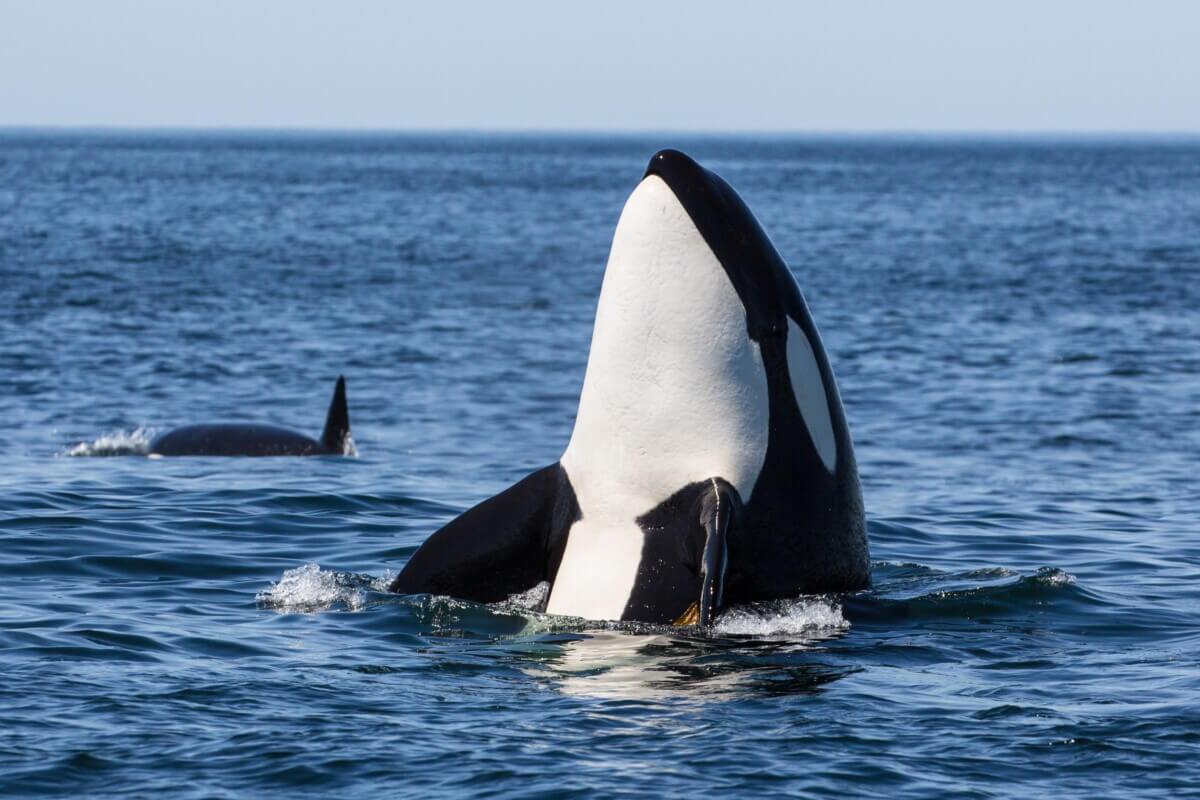
When Killer Whales Become Waiters
The documented cases span from 2004 to 2024 and occurred in locations ranging from New Zealand waters to the coasts of Norway, Mexico, and Argentina. In about one-third of the encounters, people were actually in the water with the whales. The rest happened when people were on boats or standing on shore.
The whales didn’t just drop food and swim away. In 97% of cases, they waited for humans to respond. This was typically around five seconds, though some waited as long as five minutes before deciding what to do next. When people ignored the offerings, which happened 88% of the time, the orcas typically retrieved their food and either swam away, shared it with other whales, or tried offering it again.
In the few cases where humans actually accepted the food and tossed it back to the whales, the animals immediately offered it again, almost like they were playing catch. One case involved whales repeatedly exchanging a dead seabird with researchers, creating what the scientists described as a back-and-forth interaction that resembled communication.
Jared Towers, the study’s lead author and a marine biologist with Bay Cetology in British Columbia, tells StudyFinds’ Editor-in-Chief Steve Fink that he’s experienced the strange interaction with orcas twice himself. “In both cases I was left wondering if it had really happened as it was most unusual,” he says.
Towers and his colleagues believe this behavior represents what scientists call “generalized altruism.” Essentially, the orcas are being nice to humans for no obvious benefit to themselves.

Beyond Simple Play
While some interactions did include elements of play, such as whales blowing bubbles or engaging in acrobatic behaviors, most didn’t. Only 38% of the documented cases involved what researchers classified as play behavior, meaning the food-sharing had a deeper purpose.
Scientists identified 18 different species that whales offered to humans, including six types of fish, five mammals, three invertebrates, two birds, one reptile, and one type of seaweed. Most of the offerings were freshly killed prey, though some involved live animals like jellyfish or a disabled shark.
The behavior wasn’t limited to young, playful whales either. Both male and female whales participated, spanning all age groups from calves to full-grown adults.
“The most surprising thing for me was to find that this behavior was more or less equally distributed across age classes and sexes, which I did not expect considering different sex and age classes of orcas often engage in different behaviors,” says Towers. “This really highlights that prey-sharing is a foundational behavior for all killer whales.”
Why Would Killer Whales Give Us Food?
Researchers propose several theories about why killer whales would want to feed humans, all pointing to the same underlying factor: killer whales are remarkably intelligent creatures with complex social structures.
One possibility is that these interactions represent a form of exploration. Killer whales are naturally curious animals, and offering food to humans might be their way of testing how we respond. It could be, perhaps, they’re conducting their own behavioral studies on us!
“I think killer whales are, in some cases, curious about who we are, and when they stop to offer us food it suggests they are trying to figure us out,” suggests Towers, who spends more than 100 days a year at sea studying marine life as Executive Director of Bay Cetology.
“I think the fact that this behavior is observed more often in some killer whale populations than others tells us a lot about how they differ culturally,” he adds. “For example, the most well-studied populations of killer whale in the world are fish specialists. They’ve never been observed offering people food, suggesting that, being specialists, they have to gain general knowledge through exploration of interactions with people.”
Another theory stems from the whales’ natural tendency to share food within their own communities. Killer whales regularly share prey with family members, and some populations have developed what scientists call “generalized reciprocity,” a fancy term for helping others without expecting immediate payback, understanding that such kindness builds stronger social bonds over time.
The fact that this behavior has been observed across multiple whale populations in different oceans means it’s not just a quirky habit of one particular group. Instead, it might represent a fundamental aspect of how killer whales think and behave socially.
Two Top Predators Meeting
Humans and killer whales share a unique position in the animal kingdom: we’re both top predators that evolved to dominate our respective environments. Unlike most predator-prey relationships, there’s little direct competition between our species, which might make killer whales more willing to engage with humans in a non-threatening way.
“Killer whales and humans are unique in that we are both apex predators that historically evolved exerting major top-down forces within entire marine and terrestrial realms respectively,” the researchers write in their paper.
However, the scientists included a strong warning: while these interactions might seem charming, they strongly advise against encouraging them. Killer whales are powerful, unpredictable animals capable of complex behaviors, and deliberately seeking out such encounters could be dangerous for both species.
“My advice, if anyone gets offered food by an orca, is to enjoy that rare moment, but not to accept the offering or engage with the animal,” says Towers. “Killer whales and humans, with our huge brains and strength or technology, respectively, are both capable of unintentionally harming the other through a variety of ways in which we interact.”
All the documented cases involved killer whale groups that typically hunt and feed near the ocean’s surface, often targeting air-breathing prey like seals and dolphins. Interestingly, none involved populations that primarily hunt fish in deep water using sound waves to locate prey. This difference might be important: whales that hunt near the surface in well-lit environments may be more visually oriented and adaptable in their behavior.
Some of the same individual whales were observed making food offerings on multiple occasions, and in several cases, related whales participated in the behavior, which may indicate it’s passed down through family lines as a learned cultural behavior.
These findings add to growing evidence that killer whales possess sophisticated cognitive abilities rivaling those of great apes and humans. They live in complex societies with distinct cultural traditions, use tools, and demonstrate self-awareness — and now, apparently, they’re curious enough about us to try sharing their dinner.
Paper Summary
Methodology
Researchers collected accounts of killer whales offering prey and other items to humans through their own field experiences and interviews with others who witnessed such behavior. They recorded details including date, location, number of whales involved, species being offered, whale behavior, human responses, and whether the interactions were photographed or filmed. To be included in the study, encounters had to meet specific criteria: when people were on boats, whales had to approach within their own body length and release items without being approached first; when people were in water, whales had to come within their own body length and release items in front of people who hadn’t approached within 15 meters; when people were on shore, whales had to approach directly and release items at the shoreline while people remained stationary.
Results
Scientists documented 34 cases of wild killer whales attempting to provision humans across four oceans between 2004 and 2024. The cases involved six different whale populations, with the highest number (20 cases) occurring around New Zealand. People were on boats during 21 encounters, in the water during 11, and on shore during 2. Whales offered 18 different species including fish, mammals, invertebrates, birds, reptiles, and seaweed. In 97% of cases, whales waited for human responses before reacting further. People ignored most offerings (88% of cases), but when items were accepted and returned, whales often repeated the offering behavior. All age groups and both sexes participated, with single whales making offerings in 62% of cases. Play behavior was observed in 38% of encounters.
Limitations
The study relied on opportunistic observations and interviews rather than controlled experiments, meaning not all details could be recorded for each encounter. The researchers acknowledge their methods were designed to capture only the clearest examples of provisioning behavior, which means such interactions may occur more frequently than documented. The analysis excluded cases where whales approached with items but didn’t release them, or where items were released too far from humans to constitute clear offering behavior. Additionally, the sex and age of many individual whales couldn’t be determined, limiting demographic analysis.
Funding and Disclosures
The authors declared no financial conflicts of interest. Funding sources included support from Bay Cetology contributors, Patreon supporters, the Crawford Williams Foundation, Avatar Alliance Foundation, and OceanX through the Global Orca Charity. The researchers acknowledged that data were collected from various locations including traditional territories of First Nations and indigenous cultures.
Publication Information
Towers, J. R., Visser, I. N., & Prigollini, V. (2025). “Testing the waters: Attempts by wild killer whales (Orcinus orca) to provision people (Homo sapiens),” is published in the Journal of Comparative Psychology. Advance online publication on June 30, 2025. DOI: 10.1073/pnas.2500440122


