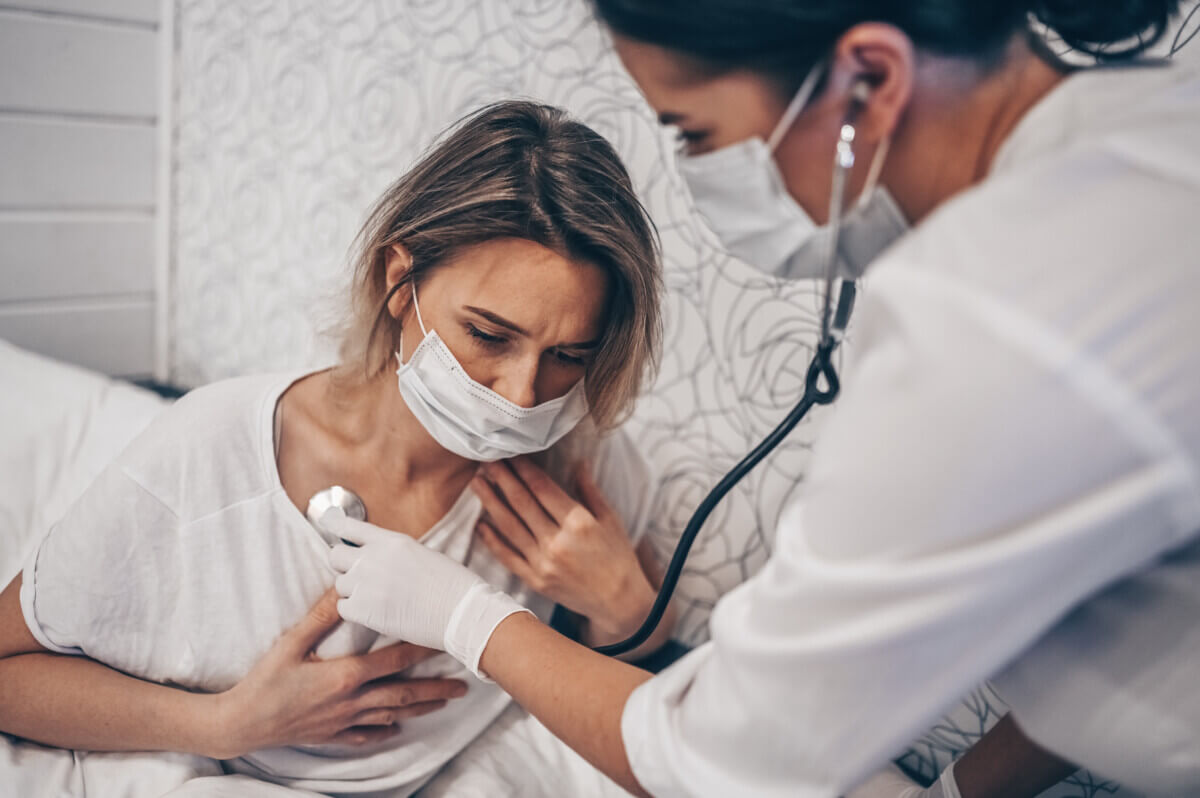
Women diagnosed with COVID-19 face a higher risk of vascular aging, new research warns. (© Алина Троева - stock.adobe.com)
Even mild infections linked to stiffer blood vessels in women, but not men.
In A Nutshell
- Women who recovered from COVID-19 showed stiffer arteries six months later, equivalent to roughly 5–10 extra years of vascular aging, depending on illness severity.
- Men did not show statistically significant changes, but women with lingering symptoms (long COVID) had worse outcomes.
- Follow-up tests suggested partial recovery over time, and vaccination appeared linked to less arterial stiffening, though more research is needed.
PARIS — When most people think about the long-term effects of COVID-19, they imagine lingering fatigue, loss of smell, or brain fog. But an international study is now pointing to a different part of the body that may carry hidden scars of infection: the arteries that keep blood flowing to the heart and brain.
Six months after catching COVID, women in the study showed blood vessels that looked years older than those of women who had never been infected. This finding held true even for women who had mild infections and never needed hospital care. Men, on the other hand, did not show the same clear changes.
The study, published in the European Heart Journal, followed 2,390 people across 38 medical centers in 18 countries, making it the first large-scale, international effort to track how COVID may affect the cardiovascular system long after recovery. The results highlight a potential gender gap in how the virus leaves its mark on the body.
How Researchers Measured Artery Aging
To understand what was happening inside people’s bodies, researchers measured something called pulse wave velocity (PWV). This is a simple way to see how stiff or flexible arteries have become. The stiffer the arteries, the faster the blood pulse travels through them. Healthy arteries work like soft, stretchy tubes that absorb each heartbeat’s pressure. As they stiffen (whether from natural aging or disease) the heart has to push harder, and the risk of cardiovascular problems climbs.
When the researchers compared COVID survivors with people who had never had the virus, they found a clear difference in women. Six months after infection, women who had stayed home during illness, as well as those hospitalized in standard wards, had noticeably higher PWV than women who were never infected. Women who had needed intensive care showed the largest jump.
To put these findings in perspective, the authors compared the measurements to reference data from other large studies. They suggested the numbers roughly lined up with about five extra years of “vascular aging” in women with mild or moderate illness, and about 7.5 years in women who had been in intensive care. The authors stress that this was an approximation (a way of translating the numbers into something relatable) not a direct measurement of aging in the participants themselves.

Why Women, Not Men, Showed Clearer Effects After COVID Infection
For men, the picture was less clear. Their numbers tended to be higher in the groups that had experienced COVID, but the differences weren’t statistically significant. In science, “not significant” means the results could have happened by chance. So while the study can say confidently that women’s arteries were affected, it cannot say the same about men.
Why only women? The study didn’t set out to answer that question directly, and the authors are cautious not to speculate too far. They note that survival bias could play a role, meaning fewer men may have survived the most severe illness to participate in the follow-up. They also point out that biological and hormonal differences between men and women could contribute, but proving that will require more research. The authors write: “Females mount more rapid and robust innate and adaptive immune responses, which can protect them from initial infection and severity. However, this same difference can increase susceptibility to prolonged autoimmune-related diseases.”
The researchers also looked at whether people who developed long COVID (symptoms that persist for months after the initial infection) had different outcomes. Among women, the answer was yes. Women who still reported problems such as fatigue, breathlessness, or muscle aches six months after infection had higher PWV than those who felt fully recovered. This connection held true regardless of how severe their initial illness had been.
This pattern didn’t appear in men, reinforcing the study’s overall finding that women are bearing the brunt of COVID’s long-term impact on arteries.
COVID Vaccination Linked to Less Arterial Stiffening
One hopeful finding came from looking at vaccination status. Women who had received at least one COVID vaccine dose before infection tended to have lower arterial stiffness compared to unvaccinated women. The researchers caution against reading too much into this, though. It’s possible that other differences (such as overall health or lifestyle choices) influenced the results. Still, it adds to a growing body of evidence suggesting that vaccination may help protect against some long-term complications of the virus.
Signs of Improvement at One-Year Follow-Up
The story wasn’t all bad news. When participants were tested again about a year after infection, women’s arteries still showed signs of stiffening, but the gap between infected and uninfected groups had narrowed. In other words, the changes looked like they might be at least partly reversible.
That’s encouraging, though it doesn’t mean the problem disappears. Blood vessel stiffening is a gradual process linked to aging, and even temporary acceleration could have health consequences down the road.
Like any study, this one comes with caveats. Researchers didn’t have measurements of participants’ arteries from before they were infected, so they can’t prove COVID caused the changes. Most of the people in the study caught the virus during the early pandemic waves, so it remains unknown whether newer strains, such as Omicron, would have the same effect. And while the changes in arterial stiffness are concerning, the study did not track whether these participants went on to develop heart attacks, strokes, or other cardiovascular events.
As the authors themselves emphasize, more research is needed (ideally studies that follow people from before infection through recovery) to understand the full picture.
Limitations and What Comes Next
With nearly 800 million COVID survivors worldwide according to the World Health Organization, even small increases in cardiovascular risk could add up to a major public health issue. The study does not suggest that every woman who caught COVID will face serious heart problems. But it does highlight a possible hidden consequence of infection: speeding up one of the body’s most basic aging processes, the gradual stiffening of the arteries.
For women, especially, it’s another reminder that COVID-19 is more than a temporary illness. Even months after the virus has left the body, its echoes may still be felt in the very blood vessels that keep us alive.
Disclaimer: This article summarizes findings from the CARTESIAN study, a large international investigation into the long-term effects of COVID-19 on blood vessel health. The study observed changes in arterial stiffness, a marker linked to cardiovascular risk, but it did not directly measure heart attacks, strokes, or other cardiovascular events. The findings are based on associations and approximations; they do not prove that COVID-19 causes premature vascular aging. Readers should not use this information as a substitute for medical advice. For personal health concerns, consult a qualified healthcare provider.
Paper Summary
Methodology
Researchers conducted the CARTESIAN study involving 2,390 participants from 38 medical centers across 18 countries. Participants were recruited between September 2020 and February 2022 and divided into four groups: COVID-negative controls and three COVID-positive groups based on disease severity (non-hospitalized, hospitalized in general wards, and ICU patients). Scientists measured arterial stiffness using carotid-femoral pulse wave velocity at 6 months after infection, with follow-up measurements at 12 months for some participants. The study used statistical models to account for differences in age, sex, cardiovascular risk factors, and other variables between groups.
Results
COVID-positive women showed higher arterial stiffness compared to COVID-negative women, with increases equivalent to 5-7.5 years of vascular aging depending on disease severity. Non-hospitalized and hospitalized women showed similar increases, while ICU patients showed the largest increase. Men showed no statistically significant differences regardless of COVID status or disease severity. Among COVID-positive women, those with persistent symptoms had higher arterial stiffness, while vaccinated women showed lower stiffness than unvaccinated women. Follow-up data suggested some improvement over time.
Limitations
The study recruited participants 6 months after infection, making it impossible to measure pre-infection arterial stiffness to definitively establish causation. The control group was smaller and not perfectly matched to hospitalized COVID groups. Some people classified as COVID-negative may have had undetected asymptomatic infections. The study focused on early pandemic variants, and most participants were infected before widespread vaccination, limiting generalizability to current variants and vaccinated populations.
Funding and Disclosures
The research was funded by grants from the Artery Society, Canadian Institutes of Health Research, Fondation Université de Paris, AXA research fund, and other medical foundations. Several medical device companies provided equipment for free use at participating centers. The researchers declared no conflicts of interest.
Publication Information
This research was published in the European Heart Journal in 2025. The study was registered on ClinicalTrials.gov (NCT04558450) and represents collaborative work from the CARTESIAN Scientific Committee.


