
(© Louis-Photo - stock.adobe.com)
Experts Warn: Legal Bans Alone Won’t Stop Teens From Driving Distracted
In a nutshell
- High school drivers spend 21% of their driving time glancing at phones, with over a quarter of those glances lasting 2+ seconds—the danger zone for crashes
- Teens are more influenced by what they think their peers are actually doing than by safety warnings or what others expect them to do
- Traditional safety campaigns may be failing because they focus on risks teens already know about, rather than addressing beliefs about productivity and entertainment
BOSTON — High school students with driver’s licenses are spending more than one-fifth of their driving time looking at their phones, according to a new study that paints an alarming picture of distracted driving among America’s youngest motorists.
Researchers found that teenage drivers reported glancing at their phones during an average of 21% of each trip, with more than a quarter of those glances lasting two seconds or longer — the critical threshold that increases crash risk by 5.5 times. Despite widespread awareness campaigns and state laws banning phone use for young drivers, the problem remains deeply entrenched in teen driving culture.
The research team, led by experts from Harvard Medical School, Brigham and Women’s Hospital, and Virginia Tech, developed what they call the Distracted Driving Belief Questionnaire (DDBQ) to dig deeper into the psychological factors driving this risky behavior. Rather than simply asking teens if they use their phones while driving, the researchers wanted to understand the beliefs, social pressures, and perceived benefits that lead to these split-second decisions behind the wheel.
Why Do Teens Use Their Phones While Driving?
The study used a two-phase approach to understand teen driving behavior. First, researchers conducted in-depth interviews with 20 high school students to identify the specific beliefs and attitudes that influence their phone use while driving. These interviews revealed that entertainment was the top reason teens reached for their phones (cited by 65% of participants), followed by texting (40%) and navigation (30%).
Students identified both positive and negative aspects of phone use while driving. They saw benefits like staying connected with family and friends, being productive, and having entertainment during drives. However, they were also well aware of the dangers, particularly the increased risk of accidents and reduced visibility.
The researchers then used these insights to create a questionnaire administered to 1,126 high school students with driver’s licenses from across the United States.
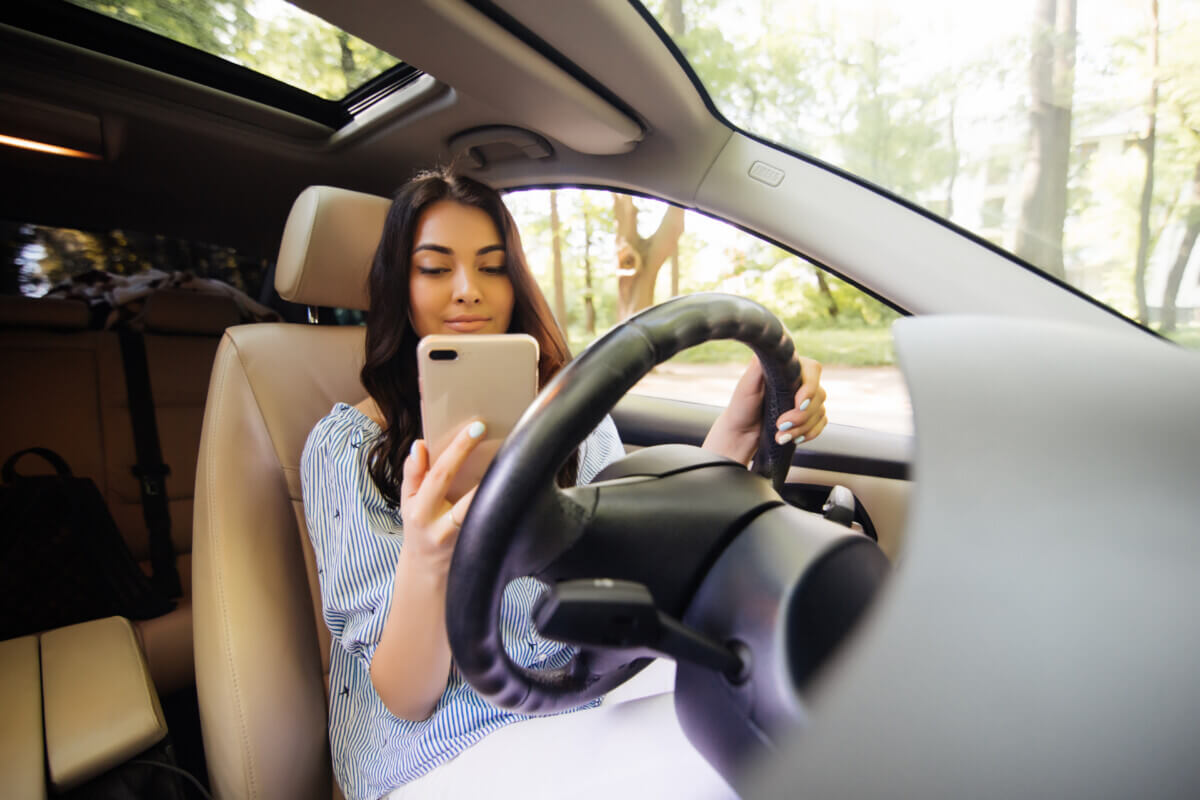
Study participants were primarily 18 years old (51%) and evenly split between male and female drivers. About 71% were White, and most were high school seniors. When asked about their phone use while driving, participants admitted to spending an average of 21.1% of each trip glancing at their phones. Even more troubling, they estimated that 26.5% of these glances lasted two seconds or longer.
The study also found that social pressure plays a huge role in this behavior. While teens believed that important people in their lives disapproved of distracted driving, they also believed that others in their peer group were regularly doing it themselves. This creates a dangerous disconnect between what teens know they should do and what they think is normal among their friends.
Beliefs That Fuel Distracted Driving
Researchers say participants expressed specific beliefs that correlate with distracted driving behavior. Teens who viewed phone use while driving as productive or entertaining were more likely to engage in the behavior. Those who strongly believed in negative consequences, like reduced visibility or increased crash risk, were less likely to look at their phones while driving.
Interestingly, researchers found that what teens thought their peers were actually doing influenced their behavior more than what they thought their peers expected them to do. In simpler terms, teens were more likely to copy what they saw others doing rather than follow what they thought others wanted them to do.
“Distracted driving is a serious public health threat and particularly concerning among young drivers. Driving distracted doesn’t just put the driver at risk of injury or death, it puts everyone else on the road in danger of an accident,” says lead author Rebecca Robbins, PhD, of Brigham and Women’s Hospital, in a statement.
How to Actually Stop Teen Distracted Driving
The study’s results suggest that traditional safety campaigns focused solely on highlighting dangers may not be enough. Since teens already understand the risks, simply telling them about crash statistics isn’t likely to change behavior.
Instead, researchers suggest that effective interventions need to address the specific beliefs that drive distracted driving. For example, campaigns could challenge the idea that checking your phone while driving makes you more productive, or promote alternative ways to stay entertained during car rides.
The study also found that getting enough sleep was linked to reduced phone use while driving, suggesting that addressing broader health issues might be an unexpected but effective approach to improving road safety.
Motor vehicle crashes remain the leading cause of death for teenagers in the United States, with distracted driving as a major contributing factor. With 35 states having banned phone use for young drivers as of December 2024, the fact that this behavior remains so prevalent shows that legal restrictions alone aren’t working.
Lawmakers should consider the finding that teen driving behavior that goes beyond simple boneheaded rule-breaking. Instead, it reveals young drivers making calculated decisions based on perceived benefits and social norms, even when they understand the potential consequences. Until safety interventions address these deeper psychological factors, the alarming statistics about teen distracted driving will likely persist, putting everyone on the road at risk.
Paper Summary
Methodology
Researchers used a two-phase approach to develop and validate the Distracted Driving Belief Questionnaire (DDBQ). In the first phase, they conducted semi-structured interviews with 20 high school students from suburban and rural areas in the Northeast and West to identify beliefs about distracted driving using the Integrative Model of Behavioral Prediction framework. These interviews explored attitudes, social norms, and perceived behavioral control related to making long glances at phones while driving. In the second phase, they administered a 38-item questionnaire to 1,126 high school students with driver’s licenses from across the United States. The questionnaire measured belief strength and evaluation for various attitudes about distracted driving, social norms, and perceived behavioral control.
Results
Participants reported spending an average of 21.1% of each trip glancing at their phones while driving, with 26.5% of these glances lasting two seconds or longer. The study found that positive outcome expectations (like being entertained or productive) were positively associated with intentions to drive distracted and actual distracted driving behaviors. Negative outcome expectations (like reduced visibility or crash risk) were inversely associated with these behaviors. Social norms played a significant role, with descriptive norms (what others actually do) being more predictive of behavior than injunctive norms (what others think you should do). The questionnaire showed good reliability with Cronbach’s alpha ranging from 0.63 to 0.87 across different measures.
Limitations
The study had several limitations, including a small sample size for the qualitative interviews and exclusion of urban schools where students are less likely to drive. The survey relied on self-reported estimates of distracted driving behavior, which may not accurately reflect actual phone use while driving. The findings may not be generalizable to urban adolescent drivers who were underrepresented in the sample.
Funding and Disclosures
The research was supported by funding from the Casey Feldman Memorial Foundation and Google. Several authors reported various consulting relationships and financial interests, with Dr. Czeisler having extensive disclosures related to sleep medicine and pharmaceutical companies. The study received IRB approval from Partners Healthcare (now Mass General Brigham).
Publication Information
The study “Designing and validating a questionnaire to understand beliefs, intentions, and behaviors relating to distracted driving in young people” was published in Traffic Injury Prevention on July 2, 2025, by authors Johanna M. Schmickler, Sheila G. Klauer, Stuart F. Quan, Matthew D. Weaver, Laura K. Barger, Charles A. Czeisler, Thamina Noorzai, Donald L. Fisher, and Rebecca Robbins. The research was conducted across multiple institutions including Harvard Medical School, Brigham and Women’s Hospital, Virginia Tech, and the University of Massachusetts.


Makes me think of a number of potential fixes–maybe an app that would automatically activate when it detects a face on the phone and a vehicle with identical GPS coordinates which are changing, and either terminate the conversation, or send out a loud warning.