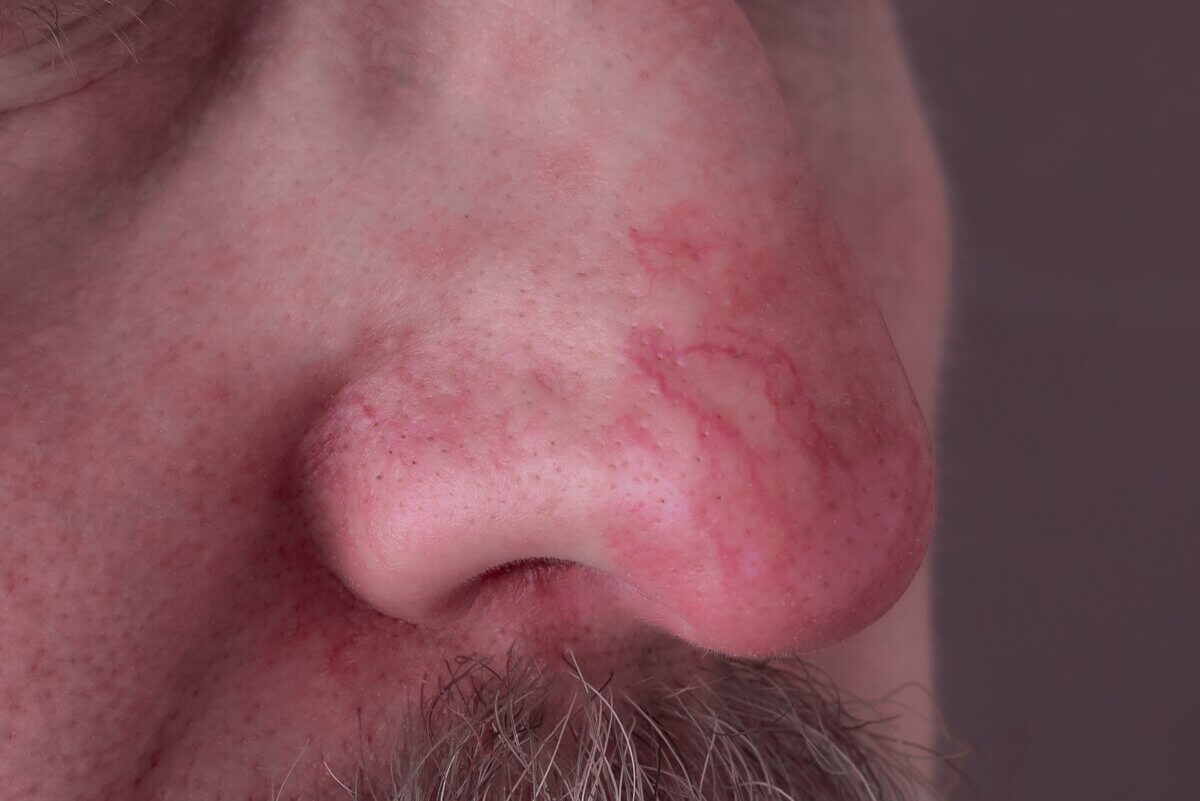
Rosacea is a long-term inflammatory skin condition that causes redness, rashes and visible blood vessels on the face, usually on the nose and cheeks. (Credit: krysvladimir/Shutterstock)
Thanks to a quirk known as unconscious selective attention, your brain has learned to ignore your nose. A prominent feature that’s positioned closely to the eyes, the schnoz could get in the way of our vision – but the nervous system cleverly filters it out.
You can choose to look for your nose, though. Either close one eye or look left, right, or downwards, and it’ll pop into view.
But, although your brain works hard to stop your nose from interfering with your line of vision, your snout is not something to ignore. Like many other parts of your body, examining the nose can help diagnose external skin conditions – and internal diseases.
Acne
While there are a number of forms of acne, acne vulgaris is the most common – and it often affects the nose.
This skin condition develops from the clogging of tiny glands in the skin that secrete protective oils, which leads to open and closed comedones. Open comedones – better known as blackheads – develop a dark colored plug, whereas closed comedones are whiteheads that form when the pore is blocked completely. Clogged pores can also develop into larger lumps and bumps which can become infected, inflamed and pus-filled and can even scar the skin.
Acne rosacea has a different appearance. It is an incurable inflammatory skin condition that causes erythema – or reddening of the skin – most often across the nose and cheeks. Patients with rosacea may often develop a rash papules and pustules that resembles acne – and also have visible blood vessels that appear as thin red or purplish lines across the nose and cheeks.
In some cases, rosacea can cause the skin of the nose to grow and thicken. This condition is referred to as rhinophyma and, like other visible skin conditions, can result in profound changes to appearance and seriously affect self-esteem in sufferers.
Both acne vulgaris and rosacea have been connected with various risk factors and health conditions, though some links are stronger than others. In the case of rosacea, the list includes high blood pressure and cholesterol, diabetes, and rheumatoid arthritis.
Wolf’s nose
Sarcoidosis is an inflammatory disease that can affect any of the body’s tissues – though mainly the lungs and lymph nodes. The condition can generate patches of bluish or purplish rashes, particularly on the body’s extremities where the skin is typically cooler. This includes the ears, the fingers and toes, and of course, the nose. When sarcoidosis affects the nose, it’s known as lupus pernio, although the name is a misnomer because this condition is not the same as the autoimmune disease known as lupus.
Regular lupus is a completely different condition where the body attacks its own tissues. It takes its name from the Latin word for “wolf” and the name dates back to medieval times when the associated skin rash was said to resemble the bite of a wolf.
When lupus, rather than sarcoidosis, affects the skin, it generates a butterfly rash – or malar rash, which fans across the cheeks and nasal bridge. This rash can look very similar to rosacea.
In fact, lupus is known as “the great imitator” because it shares similar symptoms to many different diseases.
Trigeminal trophic syndrome
Trigeminal trophic syndrome is a rare condition triggered by damage to the trigeminal nerve, which controls chewing but also gives sensation to the face. When the smaller nerve branches supplying the area of skin around the nostrils are damaged, sensation is affected. The patient notices either the skin becoming desensitized or numb – or that it prickles, like pins and needles, creating an urge to pick or scratch. Repeated damage to the skin can cause ulcers to develop around the nostrils.
This condition differs from skin picking disorder – or dermatillomania – when a psychological compulsion drives the desire to pick at the skin.
So, close one eye every now and then in order to admire your hooter or, even better, have a good look at it in the mirror. It deserves more recognition than the blind spot your brain allows.
Dan Baumgardt is a senior lecturer in the School of Physiology, Pharmacology and Neuroscience at the University of Bristol.
This article is republished from The Conversation under a Creative Commons license. Read the original article.


