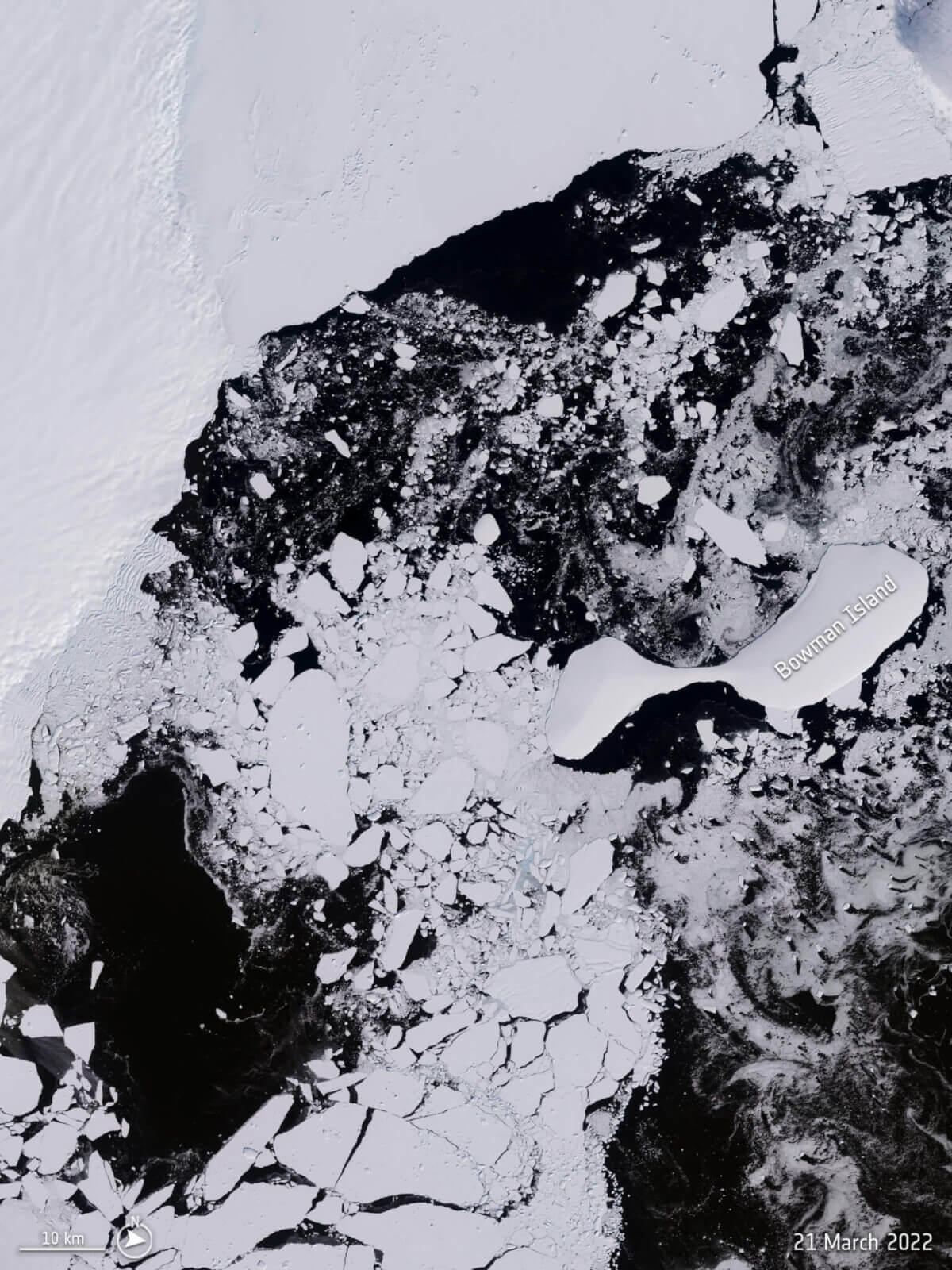
Conger ice shelf collapse in East Antarctica around March 15, 2022. (Credit: ESA) A picture released today (30 March), shows a detailed image spotted by the Copernicus Sentinel-2 mission, the Conger ice shelf collapsed in East Antarctica around 15 March. The region has experienced unusual high temperatures, with the Concordia station reaching a record of -11.8C on 18 March; the average high temperatures in March are around -48C. While the cause of the collapse of the ice shelf is not clear, global warming is likely a contributing factor. The modified Copernicus Sentinel data (2022), processed by ESA.
PARIS — A picture released today by the European Space Agency shows in dramatic detail the Conger ice shelf collapse in East Antarctica. The image was captured sometime around March 15 by the Copernicus Sentinel-2 mission.
This region of Antarctica has experienced unusually high temperatures, with the Concordia station reaching a record of -11.8C on March 18. The average high temperatures in March are around -48C.
While the cause of the collapse of the ice shelf is not clear, global warming is likely a contributing factor.
Sentinel-2 is an Earth observation mission from the Copernicus Program that systematically acquires optical imagery at high spatial resolution (10m to 60m) over land and coastal waters. The mission is currently a constellation with two satellites, Sentinel-2A and Sentinel-2B; a third satellite, Sentinel-2C, is currently undergoing testing in preparation for launch in 2024.

The mission supports a broad range of services and applications such as agricultural monitoring, emergencies management, land cover classification or water quality.
Sentinel-2 has been developed and is being operated by the European Space Agency, and the satellites were manufactured by a consortium led by Airbus Defence and Space.
Report by Dean Murray, South West News Service


