
Businessman with computer problems asking for help (© gguy - stock.adobe.com)
NEW YORK — When did tech support become a therapy session? Three out of every five IT professionals often find themselves taking on the role of an emotional counselor for users grappling with cybersecurity issues, according to a new poll.
Conducted among 2,000 U.S. employees and IT specialists, the survey shed light on common technological blunders in the workplace. The findings include incidents such as spilling coffee or water on computers (63%), alcohol spills (63%), accidentally dropping devices (45%), and succumbing to phishing scams (37%).
Consequently, about 59 percent of IT professionals frequently find themselves reassuring users before delving into the specifics of their tech issues.
Intriguingly, while cybersecurity threats loom larger than ever, 79 percent of IT experts trust that their organizational users possess the acumen to identify and thwart these threats autonomously. This confidence is reciprocated by 81 percent of employees who believe their IT departments are well-equipped to tackle cybersecurity challenges as they arise. This mutual trust can likely be attributed to regular cybersecurity education, with four in 10 IT respondents mandating monthly training and another 25 percent doing so quarterly.
This research, sponsored by LogMeIn Rescue (a GoTo product) and conducted by OnePoll, found that in spite of being well-prepared, many employees hesitate to immediately contact their IT departments. A staggering 94 percent confessed to procrastinating on reaching out, either due to their own preliminary troubleshooting (62%) or out of sheer embarrassment over their blunders (52%).
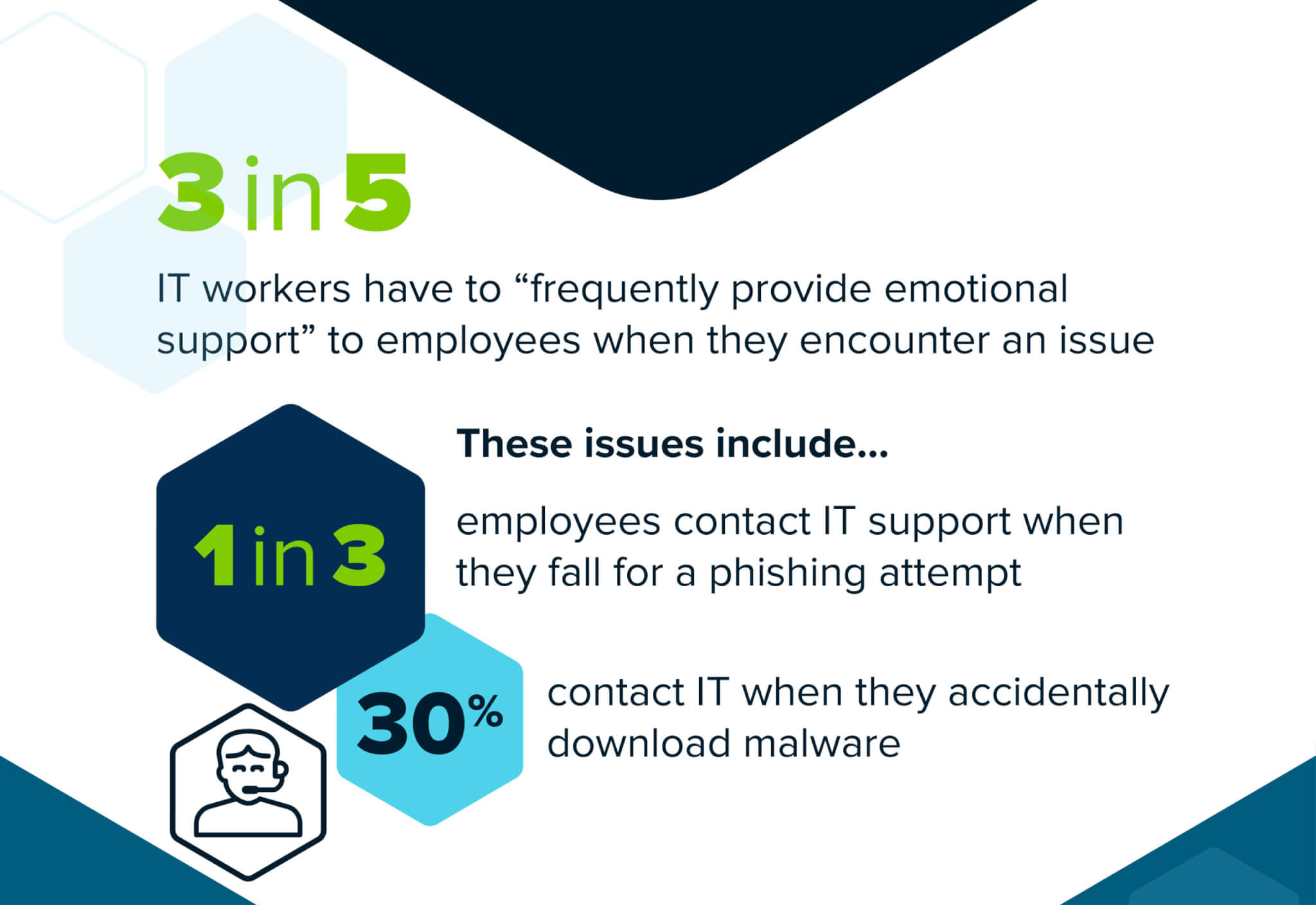
Common issues prompting users to seek IT support include being locked out of email or computer systems (60%), facing phishing attempts (48%), and grappling with internet connectivity issues (46%).
More than 60 percent of the time, IT professionals revealed that they depend on remote support or access tools to rectify user issues. The top challenges they encounter include email and computer lockouts (54%), forgotten passwords (41%), and complex in-house software problems (30%). Concerningly, 48 percent of employees recognized phishing attempts, and 39 percent had approached IT due to virus or malware concerns.
“Our latest survey shows there’s a clear understanding and a symbiotic relationship between employees and IT departments – one simply can’t succeed without the other,” says Attila Törok from CISO at GoTo in a statement.
Törok elaborated on the growing importance of this partnership amidst evolving work models, new technological integrations, and escalating cyber threats.
“Today, we’re seeing a new level of partnership between IT and employees to resolve technology issues faster and keep their systems secure,” he adds.
The surveys, structured to garner insights from both employees and IT experts about their interactions, discovered a substantial alignment in perspectives. An impressive 84 percent of employees are conscious of their IT department’s continual support, and an equivalent 85 percent of IT professionals are cognizant of users’ activities on their work devices. Furthermore, employees predominantly view their IT departments as beneficial, efficient, and prompt, with 31 percent noting responses within an hour and 15 percent experiencing immediate action.
In contrast, from the IT perspective, once an issue ticket is submitted, 22 percent claim resolution within an hour, and 42 percent by day’s end.
Reaching out to IT departments is reportedly straightforward for most employees, be it through direct messages (70%), phone calls (49%), emails (45%), or in-person visits (40%).
“Investing in a strong IT stack is non-negotiable in the current work environment, but it’s just once piece of the puzzle. Employees across the business must understand what IT does and how to work together effectively. Having easy access to your IT department and fostering positive relationships with the team are key to fixing problems fast and avoiding costly disruptions,” Törok adds.
Survey methodology:
This random double-opt-in survey of 1,000 American employees and 1,000 American IT workers was commissioned by LogMeIn Rescue (a GoTo product) between September 14 and September 19, 2023. It was conducted by market research company OnePoll, whose team members are members of the Market Research Society and have corporate membership to the American Association for Public Opinion Research (AAPOR) and the European Society for Opinion and Marketing Research (ESOMAR).
Lea la versión en español en EstudioRevela.com: Sesión de terapia de TI. Los trabajadores de soporte técnico a menudo hacen las veces de consejeros emocionales cuando las computadoras se averían.


