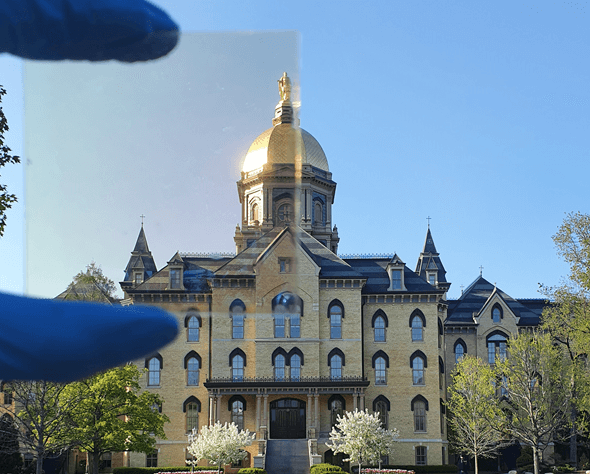
This window film (held in fingers at top left) keeps rooms bright and cool by allowing visible light to pass in while reflecting invisible infrared and ultraviolet sunlight and radiating heat into outer space. (Credit: Adapted from ACS Energy Letters 2022, DOI: 10.1021/acsenergylett.2c01969)
SOUTH BEND, Ind. — Windows that cool buildings without using energy could be on the horizon. Scientists at the University of Notre Dame are developing a clear coating that lowers temperatures without expending a single watt.
Researchers say the energy-efficient window coating keeps rooms bright and comfortable by allowing visible light in, while reflecting warm infrared and ultraviolet rays into outer space. The team’s “transparent radiative cooler” (TRC) could also be used for cars, buses and trains. With scientists pointing to global warming threatening to make summers much hotter, the need for tech that can help keep buildings cool is rising too.
The coating consists of common materials like silicon dioxide, silicon nitride, aluminum oxide or titanium dioxide. Alternating layers are placed on a glass base and topped with a film of spreadable oil called polydimethylsiloxane. Computer models calculated the type, order and combination using artificial intelligence.
“This computing method carries out optimization faster and better than conventional computers because it can efficiently test all possible combinations in a fraction of a second,” the researchers say in a media release. “This produced a coating design that, when fabricated, beat the performance of conventionally designed TRCs in addition to one of the best commercial heat-reduction glasses on the market.”
The researchers also employed quantum technology which stores data using subatomic particles. In hot, dry cities it has the potential to slash air conditioning consumption by around a third.
It opens the door to developing other composite materials. The research behind the window coating is published in the journal ACS Energy Letters.
South West News Service writer Mark Waghorn contributed to this report.


