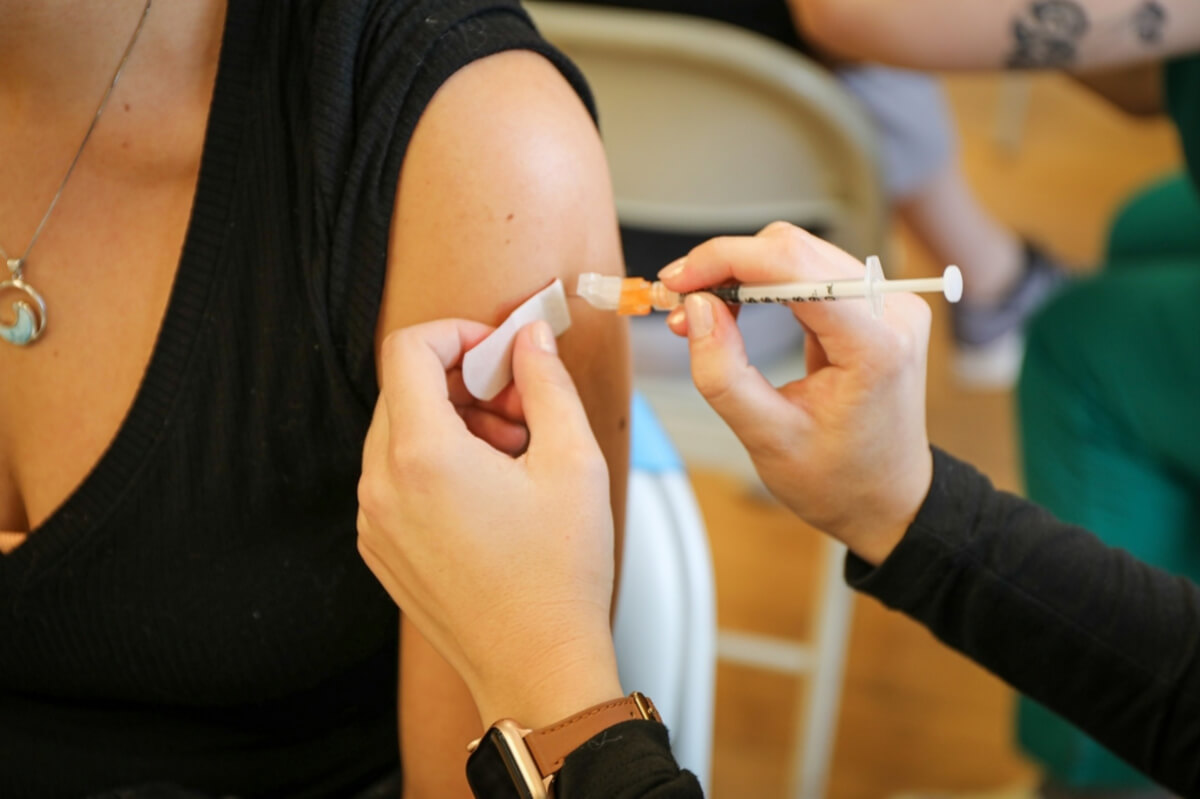
An OHSU-led study finds a substantial increase in antibody response to two-dose vaccinations when the vaccine was administered into each arm instead of both vaccines administered into one arm. (credit: OHSU/Christine Torres Hicks)
PORTLAND, Ore. — Want to boost your immunity? Just switch up your arms when you’re getting vaccinated. Researchers from Oregon Health & Science University (OHSU) have discovered that alternating arms for each dose of a multi-dose vaccine, just like the COVID-19 vaccine, could amplify the body’s immune response by up to four times.
This breakthrough finding, emerging from a study of 947 individuals, could reshape our approach to vaccination techniques worldwide. Historically, the medical community has not placed importance on the arm someone chooses for their vaccine shot. This new research, however, indicates that the choice of arm for the second dose can significantly impact the effectiveness of the immune response generated against viruses, including COVID-19 and its variants like Omicron.
The study involved OHSU employees who received their COVID-19 vaccinations early in the pandemic. These participants were randomly selected to receive their second vaccine dose in either the same arm as the first dose or the opposite arm, a method referred to as “contralateral” boosting.
After analyzing serum samples collected at various intervals post-vaccination, researchers observed a marked improvement in the immune response among individuals who received their shots in alternate arms. This enhanced immunity was not only significant against the original strain of the SARS-CoV-2 virus but showed an even more potent response to the Omicron variant, which appeared approximately a year later.
“By switching arms, you basically have memory formation in two locations instead of one,” says study senior author Dr. Marcel Curlin, associate professor of medicine (infectious diseases) in the OHSU School of Medicine and medical director of OHSU Occupational Health, in a university release.
Doing so might stimulate new immune responses in the lymph nodes of each arm. This dual-site memory formation could be the key to the observed heightened immune response.
The study’s results showed that while there was little difference in the immune response two weeks after the second dose, a significant increase in antibodies capable of neutralizing the virus was evident three weeks later, growing up to four times against the Omicron variant over four weeks.
These findings suggest that even slight improvements in vaccination techniques, such as alternating the injection site between arms, could potentially save many lives by enhancing vaccine efficacy. The research team believes this phenomenon might not be limited to COVID-19 vaccines alone but could also apply to other multi-dose vaccinations.
The study also highlights the need for further research to verify if the contralateral vaccination approach can improve immune responses to other vaccines, particularly in pediatric care where multiple prime-boost vaccine regimens are critical. Despite the promising results, Curlin cautions that it is too early to make clinical recommendations based solely on this study. However, based on the significant findings of this research, he would opt to alternate arms for future two-dose vaccines.
“I’m going to switch up my arms,” says Curlin.
The OHSU team urges for more studies to explore the potential benefits of this vaccination strategy across different age groups and for various vaccines, aiming to optimize immune protection against emerging pathogens.
The study is published in the Journal of Clinical Investigation.


“After analyzing serum samples collected at various intervals post-vaccination, researchers observed a marked improvement in the immune response among individuals who received their shots in alternate arms.”
An interesting observation, now where is the study showing that the observed changes in blood chemistry correlate with less incidence of disease? I’ll wait…..